
The European Union’s Sustainable Product Ecodesign Regulation (ESPR) will officially begin implementing the Digital Product Passport (DPP) in 2026. For clothing brands, and upstream label and tag suppliers serving the EU market, the DPP has changed from a multiple choice question of “whether or not to do it” to a mandatory question of “how to do it.
DPP requires that all textile and clothing products placed on the EU market are accompanied by a digitally readable ‘electronic ID card’ This ‘ID card’ is normally embodied in physical form as the variable QR code on the clothing tag. The question is how to produce QR code tags unique to each piece of clothing efficiently and accurately when the order size is up to hundreds of thousands or even millions of pieces?
The hanging tag UV digital inkjet printer is the core technical solution to solve this pain point. According to the mandatory requirements of DPP, this paper will focus on the application of UV digital inkjet technology in label factories for large-scale production of “one garment, one size”.
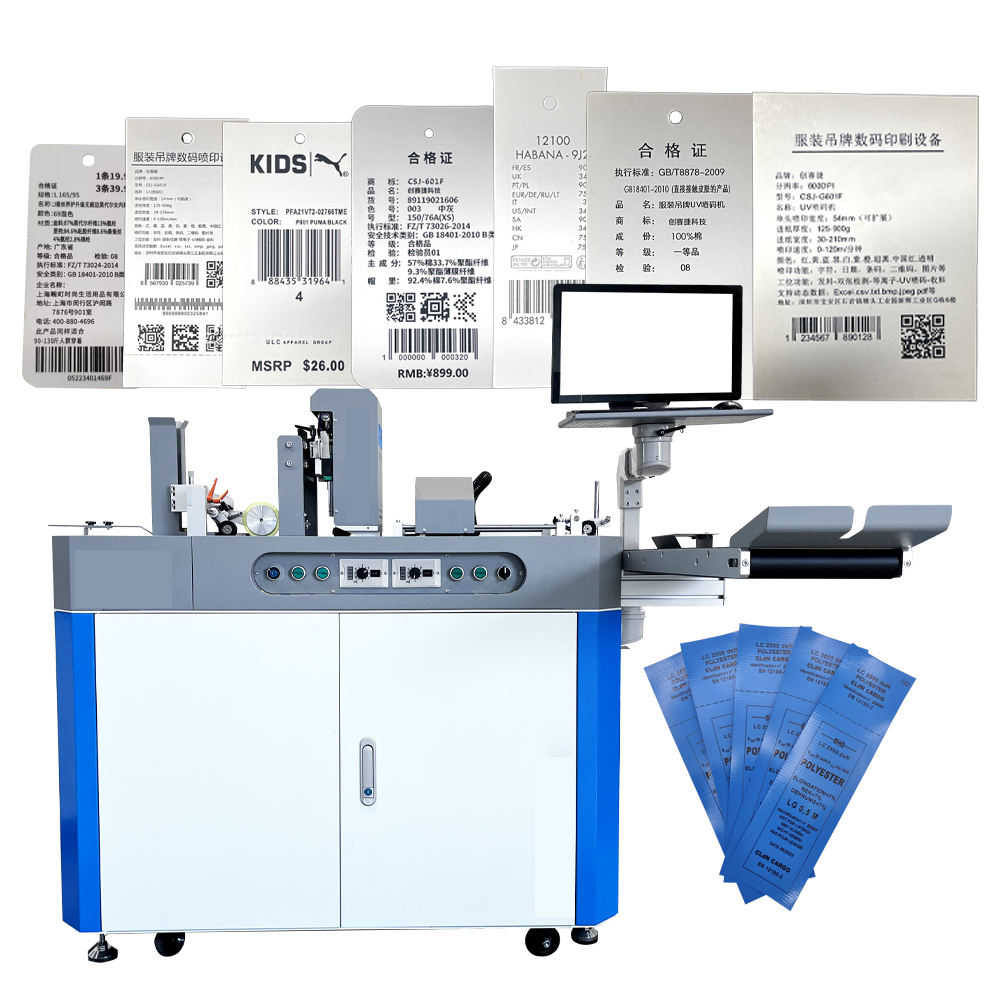
The Digital Product Passport (DPP) requires clothing labels to carry variable QR codes.
On 15 th May 2026, the European Union released the “Research on DPP Content of Textile and Clothing Products Based on the ESPR Framework”, proposed by the Joint Research Centre (JRC) to support the DPP requirements development. Under this regime, the textile and clothing products placed on the EU market in the end must contain at least 80% by weight of textile fibres, according to the DPP. The legal responsibility for registering the DPP and ensuring its accuracy rests with the economic operator placing the product on the market. If the manufacturer is outside the European Union, the obligation rests with the importer.
The fundamental working principle of DPP is that each product is connected to cloud digital records via a data carrier. The industry is looking at two main carrier solutions: QR codes and NFC chips. QR code tags can be scanned by smartphone cameras, which is a low-cost and easy-to-deploy solution. Most importantly, the QR code itself is only a doorway. The real DPP is the structured product data record behind it. This means that the QR code on the tag should be variable i.e. every article of clothing’s QR code should point to its own separate DPP record, not all clothes having the same QR code.
JRC recommends a phased data granularity approach where model hierarchy applies to macro attributes like fibre composition and environmental footprint. Batch hierarchy can be applied to variable parameters such as production facility identification and regeneration certification. The single item level supports higher-level loop patterns by serialising identifiers. At the core of DPP compliance is the principle of ‘one clothing, one code’ – each item of clothing must have a unique product identifier, visible on the clothing tag as a QR code or similar, irrespective of its stage of production.
This brings new demands to the printing of hang tags. Each hang tag has a different QR code, which needs to be dynamically generated and precisely printed in the printing process. Traditional preprint templates do not meet this requirement.
How to realise “single piece, single code” high speed seamless printing of hundreds of thousands of clothing pieces with UV digital inkjet printing
When the order volume reaches hundreds of thousands of pieces, the problem of “one size for one garment” is not only a technical problem, but also an efficiency problem. The hang tag UV digital inkjet printer is professional equipment for the large-scale variable data printing situation.
From the perspective of speed, industrial-grade hang tag UV digital inkjet printers have achieved a good production efficiency. The equipment prints at speeds of 20 to 80 meters per minute, with some high-end units reaching speeds of 150 to 180 meters per minute. Hanging tags can be printed at a rate of tens of thousands per hour, so there is a high capacity for production of hanging tags. For example, the printing speed of the single hang tag UV coding machine can reach 70 meters per minute, which can easily meet the continuous production needs of large quantities of orders. The speed advantage means that for label factories that take large-scale orders from EU brands, production capacity is no longer a bottleneck for DPP compliance.
As for accuracy, the hang tag UV digital inkjet printer is equipped with a piezoelectric industrial-grade nozzle with a printing accuracy of up to 600DPI horizontally and adjustable from 200 to 1200DPI vertically. The resolution of some models reaches as high as 1200 × 1200 DPI. The importance of high precision lies in the fact that the success rate of consumers’ scanning directly depends on the clarity of the QR code. Vague QR codes can lead to scanning failures, thereby affecting consumers’ experience of obtaining DPP information and even causing compliance risks. With the industrial-grade UV inkjet system, variable data like QR code and barcode can be accurately reproduced, ensuring that the QR code on each tag is clear, readable and accurate.
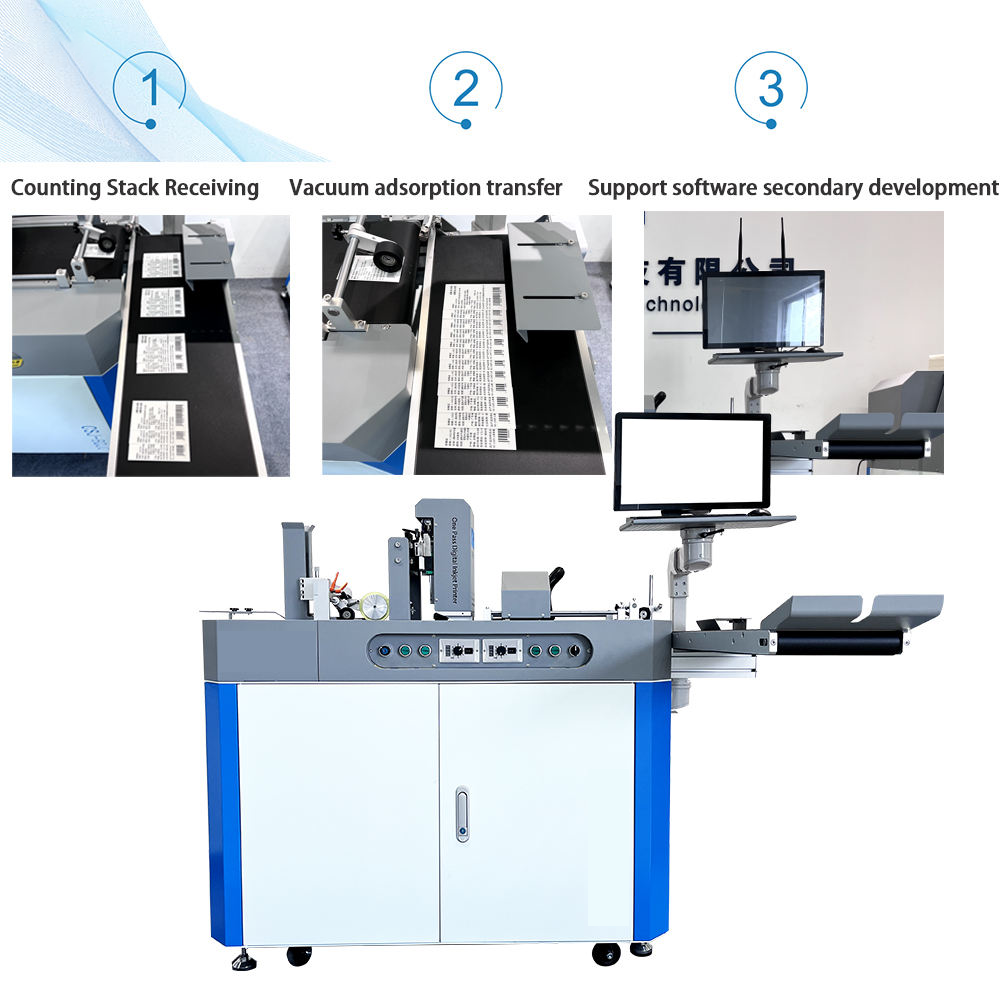
At the variable data processing level, the hang tag UV digital inkjet printer supports dynamic database printing, and can call up the variable information in the database in real time — serial numbers, variable QR codes, variable barcodes, text, etc. to achieve personalised printing of “one item, one code”. The equipment is provided with flexible coding and typesetting software, which can edit the variable information database quickly. This means that the label factory only needs to prepare the DPP data source, and the equipment can automatically complete the entire process from data calling to printing, without the need for manual intervention in setting the content of each tag.
Besides, hang tag UV digital inkjet printers are widely used in the scenarios of labelling individual items such as clothing hang tags, RFID tags, tickets, cards, and so on. It can feed accurately and collect automatically, constituting a whole automatic production line from card issuing and printing to material receiving. This “one-stop” automation capability can greatly reduce the labour cost and production errors.
How can UV curing technology without VOC emissions help the textile accessory factories to get environmental protection permit?
The logic behind DPP is to stimulate the sustainable transformation of the textile industry. Therefore, the production process of the DPP tag must also meet the environmental requirements, otherwise the paradox of “producing environmental labels in an environmentally unfriendly way” will appear. UV curing technology just solves this contradiction.
In traditional printing, the ink drying is achieved through solvent evaporation, resulting in a large amount of volatile organic compounds (VOCs). VOCs are not only a source of air pollution but are also harmful to human health. They are subject to the EU REACH regulation and OEKO-TEX® limits on strict environmental standards such as Standard 100.
UV digital inkjet technology is completely different. UV Ink UV ink is directly bonded to the material and it cures on exposure to ultraviolet light and produces minimal VOCs. UV formulations are usually at least 99.99% solids and are essentially free of volatile components. This means that label factories can cut back on VOC emissions at the source to a great extent during the production of labels.
Energy consumption: UV-LED curing technology can save up to 70% of energy compared to traditional mercury lamps. UV curing is carried out at room or low temperature, avoiding the huge energy consumption of traditional high temperature drying. The reduction of energy consumption brings not only cost savings, but also reduces the carbon footprint – which is one of the core contents that the DPP environmental footprint indicators focus on.
For textile accessory factories that are targeting the EU market, the use of UV digital inkjet printing technology without VOC emissions is itself a powerful “environmental passport”. It makes it easier for companies to pass OEKO-TEX. ® International environmental certifications such as Standard 100 are leading the DPP-compliant supply chain audits.
Typical problems of UV digital inkjet printers for hang tags
Q: What are the key differences between hang tag UV digital inkjet printers and conventional printing machines?
Conventional printing machines use fixed plates that are suited for large runs of the same type, but cannot accommodate the “variable data” needs where each tag is different. The hang tag UV digital inkjet printer adopts the digital inkjet technology without plate making, which can directly pull the variable information in the database for printing. This is the only efficient solution that meets DPP’s “one size fits all” requirement.
Q: What does the device print?
Hang tag uv digital inkjet printers have a wide material compatibility. It can offer customised printing treatment for different materials, such as flat paper card, PVC card, hang tag, PET, etc. In addition, it supports various media such as PP plastic, metal, wood, etc., which can extend to electronic tags, industrial nameplates, etc. fields. The broad material compatibility means the device can handle all types of hang tag and label jobs.
Q: The printed QR code is easy to scan with a smartphone, isn’t it?
Right. Industrial UV inkjet systems can achieve resolutions above 600 DPI, with some systems achieving 1200 × 1200 DPI. High resolution makes the edges of each module of the QR code clear and the black and white contrast sharp, so that it can fully meet the scanning and recognition requirements of smartphone cameras.
Q. How durable and stable is the equipment?
The hang tag UV digital inkjet printer is for industrial use, emphasising high stability and durability, and is suitable for large-scale and continuous production scenarios. The equipment is equipped with a closed-loop temperature control ink path system, which ensures the stability of ink supply in different ambient temperatures. The entire machine is designed to be robust, capable of withstanding long-term uninterrupted production operation, and controllable maintenance cost.
Q. Is UV ink environmentally compliant?
Yes. UV inks cure when exposed to ultraviolet radiation and contain virtually no VOCs. Meanwhile, the UV-LED curing technology saves about 70% energy compared to traditional mercury lamp. UV digital inkjet printing process with low VOC and low energy consumption properties is in compliance with EU’s increasingly stringent environmental regulations.
Q: How does the device achieve the “one item, one code”?
The equipment is equipped with flexible coding and typesetting software, and can quickly edit the database of variable information. During the production process, the system queries the unique identification information (serial number, variable QR code, etc.) of each product from the database, generates the printing data in real time, and ensures the uniqueness of the content of each tag. Everything is automatic, you don’t need to set each sheet manually.
Summary
The implementation of the EU DPP regulation is fundamentally changing the game rules of the global textile and clothing supply chain. The hang tag UV digital inkjet printer provides a technological transition path for overseas label factories from “batch printing” to “single-piece digital inkjet printing” with high-speed printing, high-precision QR code output, VOC-free UV curing technology, broad material compatibility and industrial-grade durable design.
The certainty of this trend is confirmed by market data: the global textile DPP market is projected to grow from $5.67 million in 2025 to $333 million in 2032, at a compound annual growth rate of up to 80.5%. The clothing DPP market size is projected to grow from US$13.9 million in 2025 to US$724 million by 2032, at a CAGR of 77%. This set of data clearly indicates that DPP is not a short-term policy trend, but a long term market increment that is erupting.
For Chinese enterprises that export textile accessories, instead of passively waiting for the EU’s mandatory implementation node (the Textile Authorisation Act is expected to be introduced in 2027 and officially enforced around 2029-2030 after the transition period), it is better to take the initiative and lay out the production capacity of hang tag UV digital inkjet printing in advance. Whoever first masters the large-scale production capacity of “one garment, one size” will have the initiative to take the lead in the next round of supply chain reshuffle in the EU market.

No responses yet