
With the rapid digitization of the global retail industry, hang tag printing has undergone significant changes, transitioning from traditional plate-making printing to digital on-demand production. The quality requirements for hang tags in industries such as clothing, shoes, hats, bags, and electronic consumer goods are becoming increasingly high. They not only require high-precision brand identification and product information but also urgently demand variable data printing to meet the needs of product traceability, anti-counterfeiting, and personalized marketing. The hang tag UV digital inkjet printer is a leading technological revolution in the global printing industry, with excellent characteristics of simultaneous spraying and drying of UV ink.
The hang tag UV digital inkjet printer adopts industrial-grade piezoelectric nozzles, which are instantly cured by UV ultraviolet rays. Printing can be completed without waiting for the ink to dry. The next process, such as cutting and packaging, can be completed immediately. This device can adapt well to different materials, such as paper labels (copperplate paper, white cardboard, kraft paper, double-sided tape, etc.), plastic sheets (PVC, PET, etc.), and metal foil. Equipped with a precise paper feeding system and automatic collection equipment, it can achieve one-stop continuous production from paper feeding to finished products. Shenzhen and other Pearl River Delta regions have a group of technologically mature equipment manufacturers who can provide efficient, stable, and environmentally friendly digital printing solutions for global printing enterprises. This article introduces the application value and technical advantages of UV digital inkjet printers in paper tags from three dimensions: color and adhesion of copperplate paper UV printing, direct spraying process of white cardboard/kraft paper, and variable data inkjet.
Color, adhesion, and common problem solutions for UV printing of copperplate paper hanging labels
Copperplate paper is one of the most popular types of paper used for high-end consumer goods such as clothing labels and cosmetics labels. This is because it has high gloss, smoothness, and excellent color reproduction ability. However, the poor adhesion of UV ink on the surface of copperplate paper has always been a classic problem in the industry for hanging UV digital inkjet printers. The surface coating pores of copperplate paper are relatively closed, and the wetting and curing effects of UV ink printing are limited. Local areas may have poor adhesion, ink scraping, and even batch delamination.
The solution is to fine-tune the “ink-paper interface matching” of the hang tag UV digital inkjet printer. Modern industrial UV ink is formulated and calibrated according to requirements. Copperplate paper achieves a bonding level of 5B through interface chemical bonding technology. The peel strength is constant, equal to 1.8N/cm (ASTM D3330 standard). The UV cationic curing system also provides better ink layer curing and a denser paint film structure, which can maintain gloss and color saturation for a long time. In addition, for some difficult-to-print copperplate paper (such as high-gloss mirror copperplate paper), the surface can be treated with plasma or coated with special primer to increase the surface energy of the material to 38 dynes/cm or more, which can further improve the bonding strength between the ink and the substrate.
In daily production, in addition to the two high-frequency pain points mentioned above, there are also two high-frequency pain points when using copperplate paper tag UV digital inkjet printers: 1. The scratch resistance of printed images is insufficient, and the ink layer is easily worn due to storage stacking or transportation friction. Due to ink diffusion, the edges of high-precision QR codes above 1200 dpi are not clear enough. The ratio of photoinitiator to monomer in UV ink has been optimized to have scratch resistance and is deeply cured in combination with the LED-UV curing system. The ink layer passed the 100-mesh test and 3M tape peeling test. Its wear resistance and scratch resistance are far superior to traditional water-based inkjet printing. Multi-level ink droplet control nozzles and grayscale printing technology provide clear lines and neat dot matrix edges, making QR codes clearer. In high-precision mode, the resolution can reach 1200 × 1200 dpi, ensuring a barcode scanning rate of over 99%. Ensure that it is stable.
Direct spraying process for white cardboard/kraft paper hang tags
The surface of white cardboard has high flatness and good printing adaptability. Kraft paper is often used for outdoor products, eco-friendly brands, and creative packaging due to its high strength, toughness, and environmentally friendly natural texture. It is commonly used for luxury packaging labels and high-end clothing. In traditional hang tag printing, white cardboard and kraft paper are often laminated or coated with oil to achieve waterproof, wear-resistant, and bending-resistant effects. In addition to the high cost of consumables and processing time, there are also issues with paper recycling for thin film coatings. Plastic films such as BOPP and PET seriously hinder the biodegradation and recycling of paper.
The TAG UV digital inkjet printer using direct spraying technology completely breaks this link. UV LED cold light curing technology equipment. UV ink is directly sprayed onto the surface of white cardboard and kraft paper, and ultraviolet light immediately triggers a photopolymerization reaction. Ink changes from liquid to solid within 0.1 seconds, effectively achieving a production cycle of “instant printing and drying without waiting.” UV ink solidifies to form a dense polymer ink film, which has good adhesion to the surface of paper fibers. It has good water resistance, wear resistance, and scratch resistance and does not require film covering for physical protection. This means that printing companies can recoup all their investments in the lamination process. The white cardboard tag is directly sprayed with UV, and the ink layer will not crack or lose powder after pressing and bending. After the 180-degree folding test, the adhesion force can still maintain a 5B level, completely solving the traditional bottleneck of brittle fracture in the post-processing of white cardboard.
Hanging UV digital inkjet printers are also suitable for uncoated natural paper, such as kraft paper. Kraft paper is a porous surface that contains a large amount of cellulose. UV ink spraying, fast adsorption, and curing. The ink layer combines with paper fibers to form a strong physical rivet with stable and reliable adhesion. This device can continuously print hang tags of any size from 20 × 30mm to 100 × 150mm. It is equipped with an automatic feeding platform and a paging distribution device, which can achieve fully automatic continuous production of a batch of thousands to tens of thousands of tags.
Print variable data on clothing labels.
In the clothing, footwear, and consumer electronics industries, hang tags have long surpassed the function of simply displaying information and become a key entry point for product traceability, anti-counterfeiting certification, channel management, and marketing interaction. The barcode, QR code, serial number, and batch number assigned to each product should correspond one-to-one with the product SKU. The content should be different. In traditional printing, pre-printing and re-encoding fixed content can be time-consuming and prone to errors. However, for customized tag production using variable data printing technology, UV digital inkjet printers are the most economical solution.
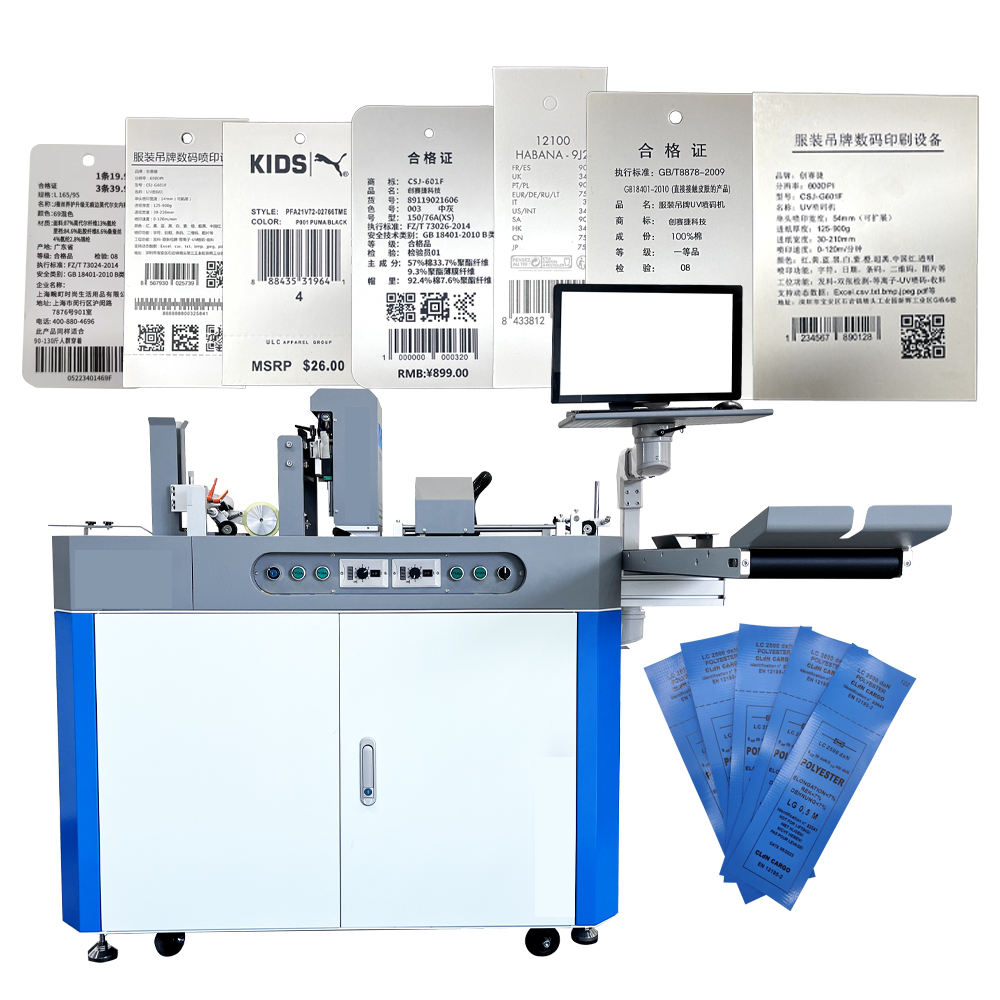
The hanging tag UV digital inkjet printer has a built-in variable data printing module, which can obtain real-time data from external databases such as Excel, Access, and ERP systems, including 1D barcodes, QR codes, data matrix QR codes, serial numbers, fixed/variable graphic content, etc. The device is equipped with high-precision industrial piezoelectric nozzles with a resolution of over 600 DPI, and the edges of barcode and QR code lines are neat and sharp, with clear black and white contrast. The accompanying operating software makes it easy to edit the variable information fields of “one print, a thousand contents”—each label in the same batch can have a different serial number, website address, or promotional code, providing brand owners with a flexible production space of thousands of people, thousands of faces, one product, and one code.
The variable data technology in UV inkjet has been proven to be very useful for many applications in the industry. For clothing labels, brands can directly print a single item traceability QR code on the label. Consumers greatly enhance their trust in brands by scanning codes to obtain clothing production batches, quality inspection information, and authenticity certifications. Electronic product labels can automatically print serial numbers, batch numbers, and anti-counterfeiting codes related to physical objects, achieving complete traceability from the production line to the terminal. More importantly, the wear resistance, scratch resistance, and waterproof performance of UV ink can ensure the long-term readability of these variable data during storage, transportation, and daily consumption, especially suitable for products such as clothing that require logistics sorting and multi-channel circulation.
It is worth mentioning that the variable data module of the hang tag UV digital inkjet printer can be connected online with the production line. The device is equipped with a visual inspection system for real-time confirmation of printed content, automatic evaluation of barcode quality, and removal of non-conforming products, ensuring the accuracy and traceability of each label’s data leaving the factory.
Core Technology Analysis of UV Digital Inkjet Printer
A deep understanding of the technical parameters and performance characteristics of hang tag UV digital inkjet printers will help practitioners to more scientifically evaluate equipment selection and production potential. According to the technical parameters of mainstream devices in the market, the core advantages of this printer are mainly reflected in the following seven aspects:
1. Fast speed. This machine adopts industrial-grade piezoelectric nozzles and a UV LED curing system. UV ink solidifies in situ under UV irradiation without the need for drying or further processing. For example, mainstream single machine models can achieve continuous high-speed output, meet the production capacity requirements of large-scale label production, and work together with automatic feeding and collection systems to achieve unmanned continuous production throughout the entire process.
2. High precision: This hang tag UV digital inkjet printer can print up to 1800 dpi, typically in a high-precision mode of 600 dpi to 1200 dpi, enough to print small font text, complex brand logos, and barcodes clearly. The success rate of terminal scanning is directly proportional to the sharpness of the edges of high-precision QR codes and dot matrix codes. Nowadays, the preferred technology for variable data printing is UV inkjet printing to ensure barcode quality.
3. Color saturation. Full-color UV printing can be CMYK four-color or light color, such as light cyan/light magenta, with rich color expression and can handle various designs from gradients to local spot colors. UV ink has a high solid content and forms a transparent ink film after curing. The color saturation and weather resistance of the hang tag logo, brand main color, and decorative pattern are better than water-based printing.
4. Personalized customization. Support variable data printing, one-to-one coding printing, and on-demand content customization to meet the diverse needs of different brands in anti-counterfeiting, traceability, and promotion scenarios. Production order changes do not require changing the sheet metal. Small plots of land are easy to handle. The hang tag digital printer can print various document formats, such as images, PDFs, Word documents, etc. A device can perform fixed information batch printing and personalized data-driven printing.
5. Mature technology. UV digital inkjet coding system for integrated printing and precuring of hang tags. The UV LED curing system has the characteristics of low thermal radiation, controllable energy consumption, and long nozzle life. The whole machine has high stability, and the industrial piezoelectric nozzle adopts multi-stage ink droplet control and automatic cleaning and maintenance technology, which is not easy to operate for a long time.
6. The structure is sturdy and durable. The main body of the equipment is usually a fully steel-welded gantry structure integrated with high-precision guide rails and a closed-loop servo motion control system, ensuring the flatness of the platform and the consistency of printing positions in high-strength continuous production. The whole machine has passed international certifications such as CE and CCC and can meet the industrial-grade durability requirements for 24-hour continuous operation in the factory.
7. Good material compatibility: UV digital inkjet printers used for hanging labels can print on paper labels (copperplate paper, white cardboard, craft paper, double-sided tape, specialty paper, etc.) and plastic sheets (PVC, PET, PC, PP, adhesive labels, etc.). The model can be extended to metal foil, synthetic materials, and thin aluminum foil. The advantage of cross-media adaptability is that printing companies do not have to invest in additional equipment for new materials.
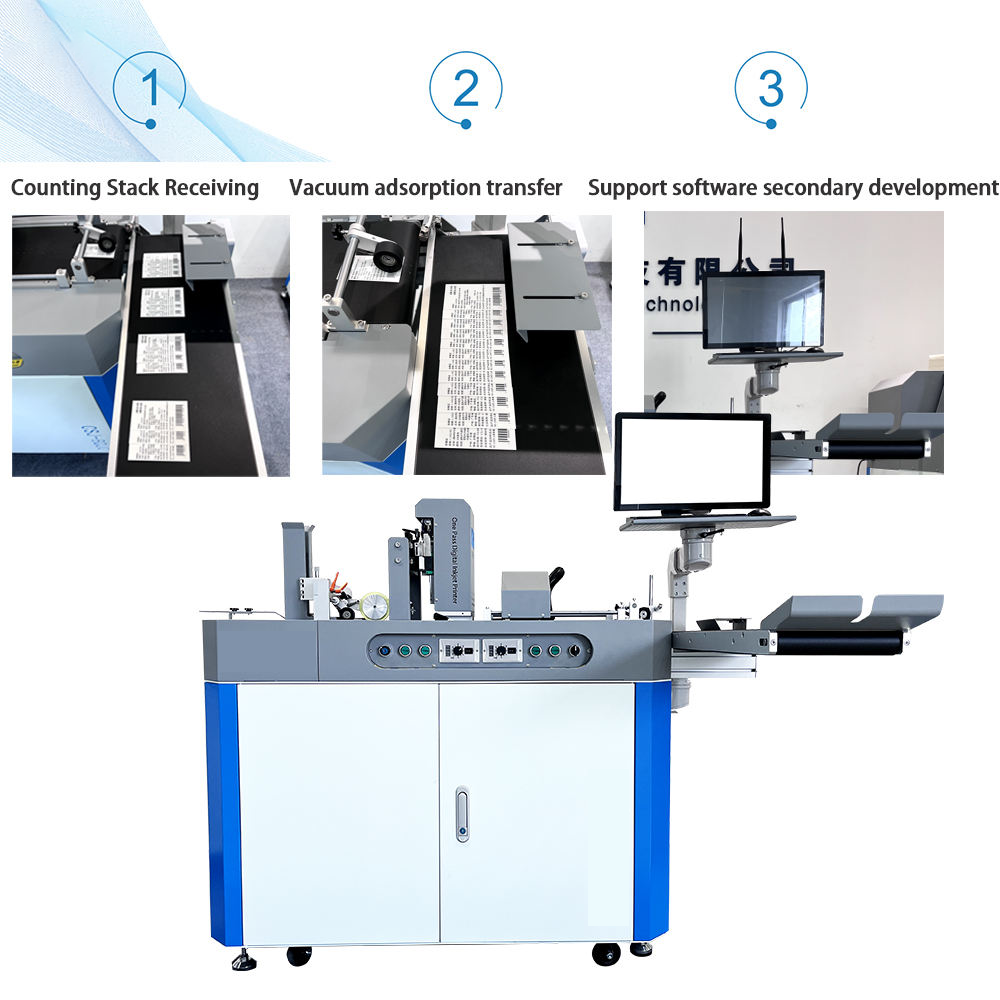
Based on the hardware architecture of the device, the precise feeding and automatic receiving system greatly improves the operational efficiency of the hang tag UV digital inkjet printer. The paging feeding device or upward suction feeding system can achieve stable processing and continuous long-distance feeding of single-label paper through a closed-loop transmission platform, greatly reducing the time and error of manual feeding. The automatic material receiving device has stacking and counting functions. The operator only needs to regularly remove the finished material pile. The integrated visual inspection module can also capture printing defects in real time and automatically delete defective products in the fully automated model, ensuring that each cut is a qualified label after quality verification. The core engine for printing enterprises to achieve large-scale and intelligent production is to use TAG UV digital inkjet printers to automate the entire process from paper feeding to finished products.
Conclusion
The above analysis indicates that UV digital inkjet printers used for hanging tags have demonstrated irreplaceable technological advantages in the field of paper hanging tag printing. By optimizing the formula of UV ink and applying interface chemical bonding technology, high-quality printing with 5B level adhesion and 1.8N/cm peel strength can be achieved on copperplate paper. The film-free direct spraying process can be integrated with LED cold light sources and immediately dried on white cardboard and kraft paper, which not only saves the cost and turnover time of film coating but also meets the growing demand of brands for environmentally friendly packaging. In the field of variable data printing, based on high-precision nozzles and database-driven printing modules, this device can achieve smooth one-to-one production of barcodes, QR codes, and serial numbers, creating practical value in areas such as clothing anti-counterfeiting traceability, store interactive marketing, and supply chain traceability.
The global UV inkjet label printing machine market is expected to steadily grow: According to the latest data released by QYResearch, the global sales of UV inkjet label printing machines are expected to reach $905 million in 2026 and $1.208 billion in 2032, with a compound annual growth rate of 4.2% (2026-2032). From a larger-scale perspective, by 2025, the total size of the global UV printer market will have reached approximately $1.5 billion, with packaging printing accounting for 24%, and this proportion is still growing rapidly. According to our forecast, the UV digital inkjet printing market will increase from $1.437 billion in 2026 to $2.013 billion by 2030, with an annual growth rate (CAGR) of 4.42%. The data clearly indicates that UV inkjet digital printing technology is accelerating its penetration into the global printing industry, and hang tags, as an important component of packaging and consumer product labels, are also playing a significant role in it.
In summary, the core competitiveness of hang tag UV digital inkjet printers lies in high speed, high precision, color saturation, personalized customization, mature technology, sturdy and durable design, and strong material compatibility. The UV digital inkjet printer used for hanging tags is a powerful tool to replace traditional plate-making printing. It is also an important platform for printing enterprises to achieve digital transformation and expand flexible production capabilities. For printing professionals who carefully choose their technological path and strike a balance between cost-effectiveness and product quality, the most important issue in the industry has always been to balance the one-time investment in equipment with long-term production profits. The answer is the same as the technological foundation for investing in disposable equipment and converting it into sustainable output, which is the hanging UV digital inkjet printer.

No responses yet