UV digital printers suffer from “material compatibility differences” mainly due to differences in substrate surface free energy (dyne value), material polarity, and mismatched thermal expansion coefficients. Adhesion failure is mainly seen as detachment from the hundred-grid test or peeling of the coating, which is mainly caused by the low surface tension of the substrate, false curing, and the mismatch of ink hardness. The risk of weather resistance is manifested as outdoor yellowing, fading or powdering, which is mainly caused by the physical stress damage caused by UV aging, residual photoinitiators and wet-heat alternation.
The core of this problem is not only the promotional parameters of the equipment itself, but to create a standard system process of plasma “surface pretreatment + ink/curing wavelength accurate matching + industrial-grade drying/temperature control” of the substrate.
Why “universal printing” is a pseudo-proposition: the logic behind differences in material compatibility
The term “universal printing” is frequently used in sales language to describe the versatility of UV curing technology. But in the practice of industrial production, no ink and hardware configuration can be perfectly matched to all materials without adjustment. To understand material compatibility we must return to the mechanisms of physics and chemistry underlying the phenomena.
[Substrate surface tension (dyne value)] [UV ink droplet wetting ability]——–>[Chemical bonding/anchoring effect]
The correlation between surface free energy and Dyne value.
The spreading and sticking of the ink on the surface of the substrate is governed by the difference between the surface free energy of the substrate (usually expressed as a Dyne/cm value) and the surface tension of the ink.
- high intrinsic value materials (paper, processed metals): surface free energy is generally $> 40 \ \text{dyne/cm}$, it is easy to wet the ink and develop colors and it is relatively easy to achieve adhesion.
- Low-impact materials (such as PP, PE, untreated organic glass and fluorocarbon coatings). The surface free energy is often less than $32 \ dyne/cm$. Ink will quickly shrink into bead-like (bead phenomenon) after spraying, and a continuous ink film cannot be formed, resulting in a sharp decrease in adhesion.
Effect of substrate crystallinity and chemical polarity on intermolecular forces
Surface tension is not the only factor in adhesion. Factors of intermolecular forces (van der Waals forces and hydrogen bonds) are also the determinants of adhesion. Nonpolar or highly crystalline plastics (such as nonpolar polypropylene) do not contain any polar functional groups that can crosslink with UV ink monomers. The ink could only be attached on the surface with fragile physical and mechanical interlocking after curing in the absence of any surface modification, which could be easily peeled off by external force.
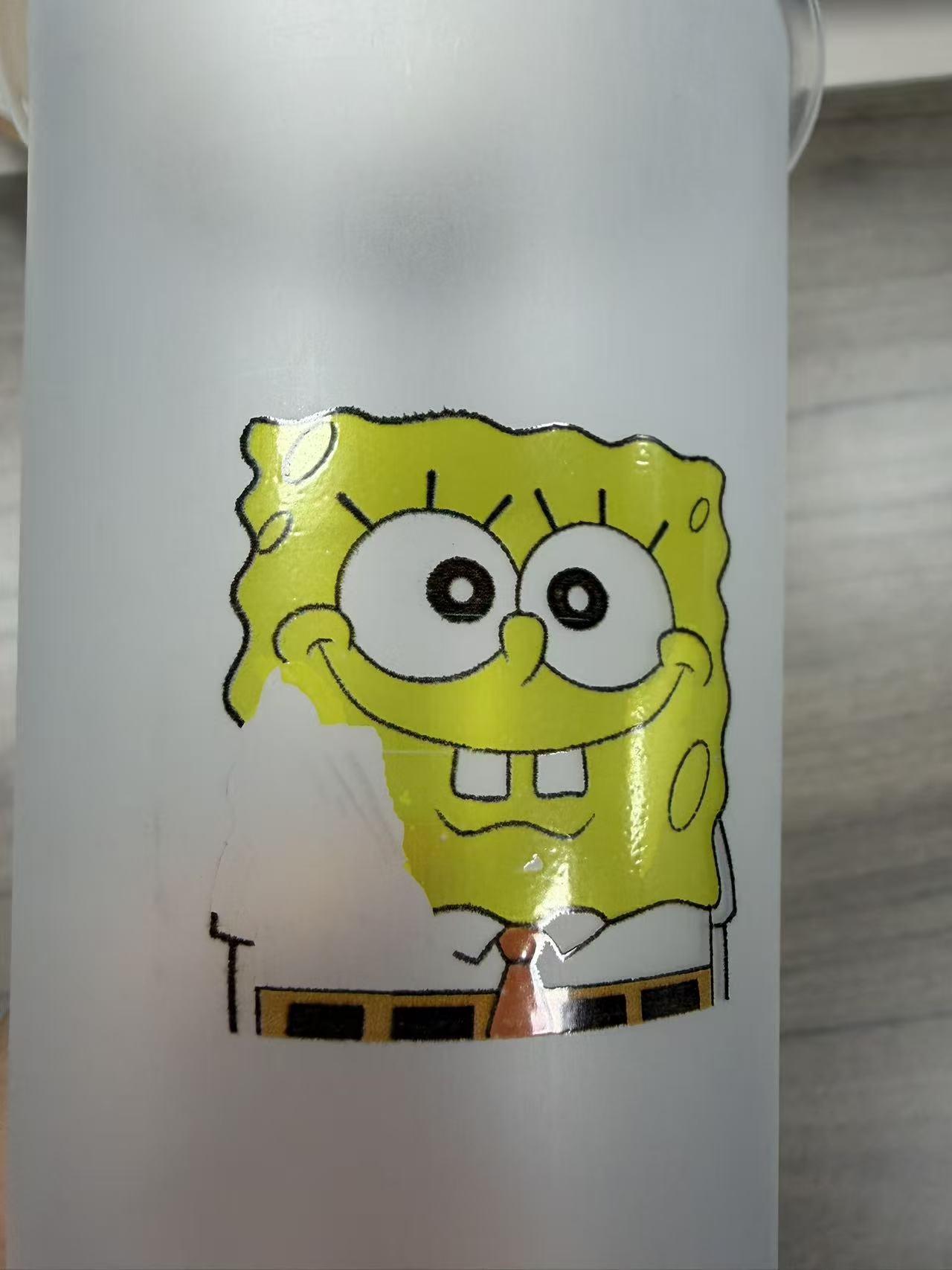
Research on the main types and mechanisms of adhesion failure
Adhesion risks in industrial mass production are not always obvious at first glance, but have often concealment and lag.
Concentration and pseudostabilization of the internal stresses
The “dry on the surface but not dry on the inside” phenomenon will occur if the UV LED curing lamp has insufficient energy or the wavelength does not match the photoinitiator in the ink. The surface ink film appears to have solidified, but the monomers adjacent to the substrate layer at the bottom did not polymerize completely. On the other hand, unreacted monomers can diffuse during curing or the volume shrinkage during curing can generate significant internal shrinkage stress which in turn causes the whole ink layer to delaminate from the substrate.
Ink fracture mechanism on irregular/bent substrates, flexible and rigid
The selection of ink type is significant when choosing a multi-material UV digital printer.
Hard Ink: hardness is high, scratch-proof. But for flexible substrates such as bent leather, TPU, PVC film, etc., the hard ink film can’t bear tensile stress, and once the material is deformed under stress, the ink film will crack, or even peel off in sheets.
Soft ink: good flexibility, poor scratch resistance and poor surface adhesion on hard substrates (e.g. metal, glass).
Weather resistance risk: a silent killer for outdoor service life
Weather resistance is a direct factor influencing the after-sales warranty period of the product in applications such as outdoor signage, building materials and car stickers.
[UV-A/B]+[wet heat cycle]+[acid rain/salt spray] –> polymer molecular chain cleavage –> fading, powdering, peeling
Degradation of Photoinitiators and Ultraviolet (UV) Radiation
UV-cured ink is polymerized by ultraviolet radiation but the photoinitiator within the ink film is still partially consumed after curing. During high exposure of outdoor light, the remaining photoinitiators will continue to generate free radicals which will induce secondary degradation (photoaging) of the polymer backbone of the ink film polymer backbone, leading to yellowing, brittleness, powdering of the ink film, and a sharp drop in color saturation.
Thermal cycling, temperature/humidity cycling, thermal expansion and contraction stress failure
The thermal expansion coefficients of different materials are quite different. For example, the coefficient of thermal expansion of aluminum-plastic panels and organic glass (acrylic) is fundamentally different. In case of large temperature differences between day and night or humid and hot, the rate of expansion/contraction of the substrate and the cured ink film is not the same, which causes sustained shear stress at the interface. After hundreds of temperature and humidity cycles, the interfacial adhesion will be completely destroyed, and there will be massive foaming or peeling of the ink film.
Table of Compatibility and Risk Assessment for Common Industrial Substrates
To help the production and technology departments to find out the risks quickly, the following table summarizes the common characteristics and coping strategies of the common industrial substrates in UV printing:
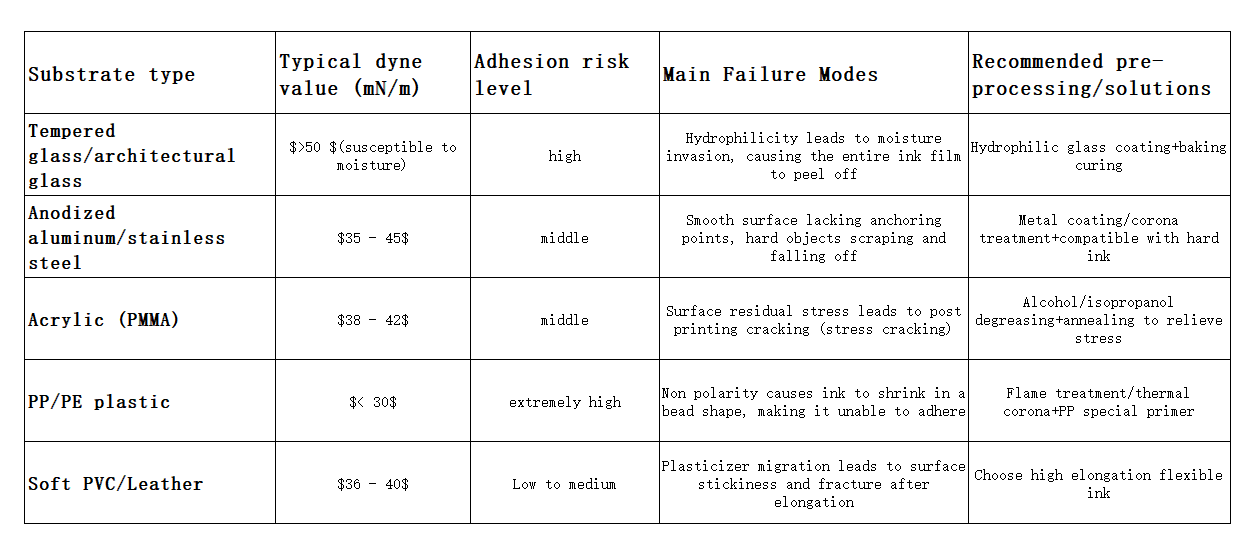
Important note: If the risk of the increase of scrap rate resulting from poor adhesion during the production process is not taken into account in the early equipment selection and scheme planning, the expected production cost may be seriously deviated from. Regarding the effect of process control on the overall equipment efficiency, there are detailed quantitative calculations in the comprehensive investment return analysis of UV printing equipment.
Four systematic solutions to mitigate adhesion and weathering resistance risks
To remove the quality hazards associated with the material compatibility, it is necessary to move away from the single “parameter adjustment” approach to a “systems engineering” approach.
[Pretreatment of substrates] ——->[Precise matching of inks and wavelengths] ——->[Stable output from industrial-grade hardware] ——->[Standardized QA testing]
1.Precise process flow of pretreatment
Physical methods, e.g. flame, corona, plasma treatment. The dyne value can be enhanced to more than $42 \text dyne/cm}$ by altering the molecular structure of the plastic surface and adding polar groups through high voltage discharge or flame.
Chemical coating method: Inorganic materials such as glass, metal and ceramic tiles are applied with a special primer containing silane coupling agent. The coupling agent is covalently bonded to the acrylic monomer of the UV ink on one end and bonded to the inorganic substrate on the other end to form a strong “molecular bridge.”
2.Ink formulation matching with curing wavelength (365nm vs 395nm)
In general, LED-UV cold light sources are used for industrial grade curing. The principal wavelengths are 365 nm and 395 nm:
365 nm wavelength: High energy, strong penetration, more conducive to deep curing of deep ink (such as high concentration white ink or thick coating).
Wavelength 395nm: good for fast surface drying.
If the wavelengths are not consistent, it will very likely result in the above-mentioned “pseudo-curing.” For the detailed energy matching mechanism of the light source, it can refer to the analysis of wavelength matching technology for UV curing lamps.
3.Industrial UV digital printers, with hardware support for temperature control and feathering
Physical printing of high quality demands precise control of hardware equipment. When choosing, a qualified industrial-grade flatbed UV printer should guarantee the following key hardware:
Negative pressure temperature control system: Ensure the viscosity of the ink is stable at a certain temperature (for example, $35 ^ \ \circ \text {C} -45 ^ \ \circ \text {C} $), so as not to cause unstable inkjet output due to differences in environmental temperature, which may affect the thickness and adhesion of the ink film.
Multi-level feathering printing algorithm: reduce the internal stress caused by edge hardening and ink accumulation, make the ink film thickness transition in the gradient area smooth, and reduce the risk of edge peeling.
4.Standard quality inspection system
Visual inspection alone is not enough to determine the quality of the product before mass production, but strict laboratory testing must be done:
Cross Hatch Adhesion Test (ISO 2409/ASTM D3359): Draw a matrix grid with a grid cutter, apply 3M 600 tape, and quickly pull to observe the peeling area of the grid.
Artificial Accelerated aging test (QUV Aging Test): The “light condensation” cycle test in a UV fluorescence aging chamber simulates the color difference (ΔE) and gloss retention after 1-3 years of outdoor use.
Common Operations Mistakes
Fallacy 1: Blind belief on the slogan of “print all material without wiping the coating”.
Fact: It is not possible to achieve long term stable industrial grade adhesion with untreated low polarity materials due to the laws of physics.
Misconception 2: The more powerful the UV lamp and the longer the irradiation time, the more effective.
Fact: Over-irradiation leads to over-crosslinking of the ink film, making the ink layer extremely fragile and brittle, reducing its impact and bending resistance.
Myth 3: Ignoring the impact of environmental temperature and humidity on surface condensation.
Fact: In high humidity conditions, there will be a water film that cannot be seen by the naked eye on the surface of the substrate, which directly isolates the ink from the substrate, resulting in batch paint peeling accidents.
Myth 4: Not thinking about the daily condition of the print head and its effect on inkjet accuracy.
Poor ignition of the nozzle or partial blockage of the nozzle holes can form ink droplets that fly off course. These form tiny gaps where moisture and oxygen easily penetrate to cause edge peeling. For calibration and maintenance of nozzle status, please refer to the daily maintenance technical guide for printing nozzles.
Further Reading (Related Guides)
The following technical guidelines and practical cases can further improve the printing quality and efficiency:
- In-depth analysis of the overall construction of production line, waste rate control and investment return ratio calculation of UV digital printers. Industry pain points, real cases and investment return quantitative analysis.
- Choice Strategy of LED Light Source and Matching of Wavelength of UV Curing Lamp-Analysis of the Effects of 365 nm and 395 nm Light Sources on Different Ink Crosslinking Degrees.
- Industrial Grade Nozzles: Daily Maintenance and High-Frequency Troubleshooting– A Maintenance Manual for Consistent Inkjet Accuracy and Physical Adhesion
FAQs (Frequently Asked Questions)
Q1: Why does the ink printed on acrylic not fall off during the hundred-grid test, but bursts when cut?
This is because of the heat and mechanical stress generated during the cutting of acrylic which causes ink film fission or the presence of significant residual stress within the acrylic sheet itself. It is recommended to clean the surface with isopropanol or annealing treatment before printing after cutting. At the same time, check whether the ink formulas with excessive hardness have been used.
Q2: How to quickly judge whether a new material needs to be coated?
The easiest way is to measure the surface tension of the substrate using a Dyne Test Pen. When the measured surface tension is less than $38 \ \text { dyne/cm} $ or the material surface is very smooth and pore free (e.g. uncoated glass/stainless steel) it is usually necessary to undergo pre-treatment or wipe a special coating.
Q3: How to extend the weather resistance and color retention life of UV-printed products for outdoor application?
The common methods to prolong the weather resistance life are: 1) use industrial outdoor ink, which has a high degree of photo-curing crosslinking and contains anti-yellowing initiators; 2) Coat the surface of the printed product with a UV-resistant varnish or protective film. 3) Use a UV curing lamp with enough energy to avoid unreacted monomers to remain.
Q4:Can I combine hard and soft inks and use them?
Answer: absolutely not to be mixed. The soft ink and hard ink have different monomer structure, proportion of resin and proportion of photoinitiator. Direct mixing could change the rheological property of the ink and the nozzle could be easily clogged. Uneven physical properties (e.g. surface tackiness and internal bubbling) may appear after curing.
Summary and Buying Recommendations.
The risk of adhesion and weather resistance caused by material compatibility is basically a balance between the physical properties of the material and the chemical reaction process. When designing and building an industrial-grade UV digital printer production line, it is recommended to follow these steps:
The sampling stage is to set up testing standards. It is not enough to just do “visual inspection of color”, the standard process must include 100-grid testing, wear resistance testing, and baking/humidity testing.
Pay attention to the matching of software and hardware ecology: after determining the main printing substrate, synchronously choose the matching ink type, preprocessing equipment, UV LED light source combination.
Improve environmental and human-machine operation procedures: Strictly control the temperature and humidity of the workshop, and standardize the substrate oil removal, dust removal and electrostatic removal procedures.
No responses yet