Key points in the selection and use of UV digital printer consumables
The consumables of UV digital printer mainly include UV-curable ink (hard, soft and neutral), pre-treatment primer/post-treatment varnish, special cleaning solution and moisturising maintenance solution. The basic principles governing selection and use are:
1.Ink matching medium: For hard materials like acrylic and glass, use durable ink. For soft materials like leather and TPU, use soft ink and do not mix them.
2.You can not mix cleaning fluids and maintenance fluids. Cleaning fluids are used to remove blockages, maintenance fluids are used to moisturise the head. Mixing the two can damage the sealing ring of the nozzle or the crystal.
3. Wavelength and waveform matching: The ink initiator must match the UV-LED curing wavelength (typically 395 nm or 365 nm) and the piezoelectric driving waveform of the device to ensure proper curing and to prolong the life of the nozzle.
If you want to systematically understand the equipment’s overall architecture, you can refer to our UV digital printer material compatibility and core component selection guide.

1.Classification and Features of the Core Consumables for UV Digital Printers
Materials in industrial UV digital printing systems have a direct impact on the quality of the printed colour, its tackiness, durability, the lifespan of the piezoelectric nozzle, and the performance of the equipment as a whole.
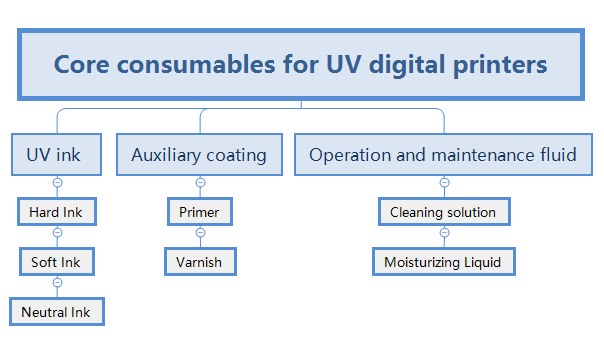
1. UV-curable inks: Classification and application scenarios
UV ink is composed of photocurable resin, monomers, photoinitiators, pigments and additives mainly. The photoinitiator, under UV-LED illumination, absorbs particular ultraviolet light wavelengths to trigger polymerisation reactions, converting the ink from a liquid to a solid state in a very short time.
CMYK basic ink: a foundation for image colour restoration.
White Ink: Contains titanium dioxide particles with high specific gravity and is generally used as a base for dark or transparent media and requires a circulating mixing system to prevent sedimentation.
Spot/extended colour ink (like LC, LM and spot green/orange) for smoother transition colours and wider colour gamut printing.
2.Primer & Varnish
Primer/PP Liquid – This is for smooth or low energy surfaces such as glass, metal, stainless steel or untreated PP/PE. It helps to change the surface tension of these materials so that the ink sticks better.
Varnish: This is applied to the surface of printed materials to give a shiny, matte or raised effect, and also provides extra protection against wear and chemical damage.
3.Cleaning & Maintenance Fluids
Cleaning Fluid: It has a strong solubility and is used to dissolve uncured residue ink and clean the ink deposition on the flow channel and flash spray blade.
Maintenance fluid. It has a very low evaporation rate and mild chemical properties, mainly used for long-term holiday sealing, daily shutdown moisturising, and preventing microhole agglomeration of the nozzle.
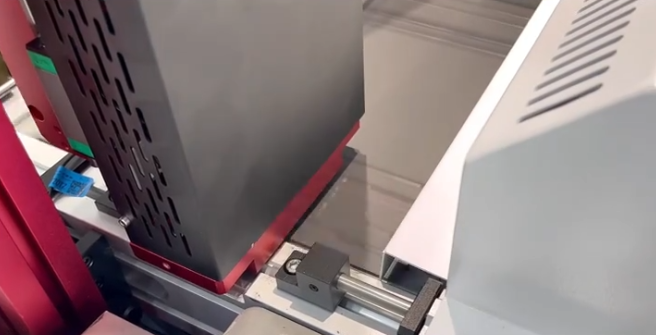
2.How to choose the right UV ink for printing materials and processes
Unsuitable ink selection can not only cause the printed product to peel and crack paint, but can damage the driving crystal of the piezoelectric nozzle because of the mismatch of the ink viscosity.
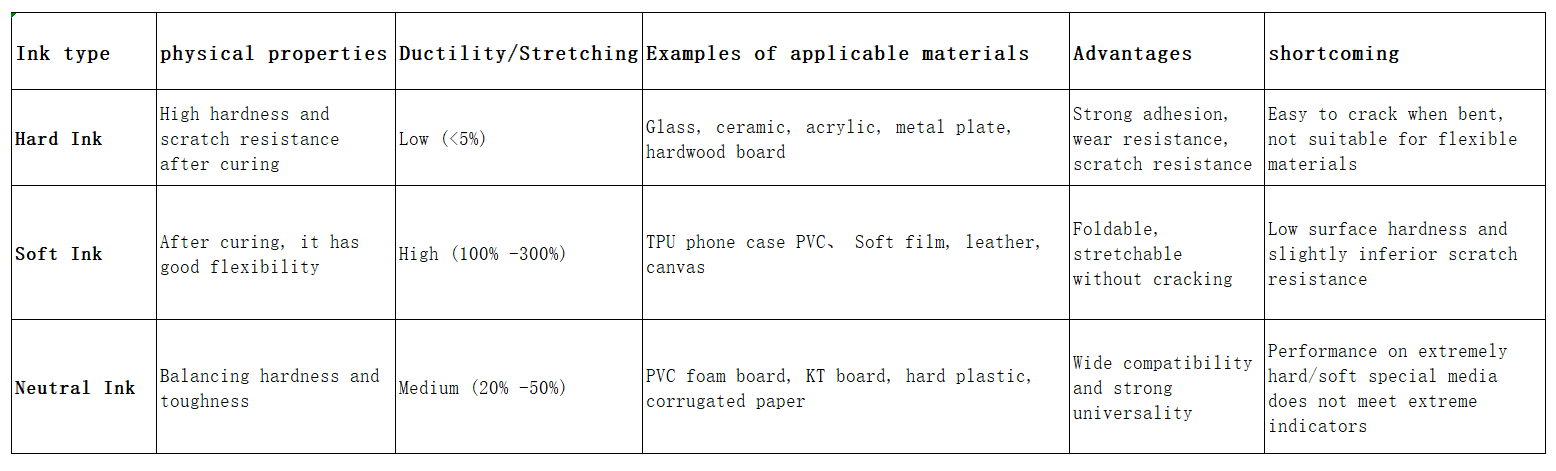
1. Matching rule of physical properties
The choice of ink is made according to the reprocessing requirements of the processed workpiece:
If you need to cut, stamp or bend after printing, the first choice should be a soft or neutral ink.
If the printed material is to be exposed to the outdoors for a long period of time and is subject to frequent friction (such as labels or casings of electronic products), it is recommended to choose durable ink with high hardness.
2. Colour gamut, viscosity and wavelength matching
Viscosity & Temperature Industrial-grade piezoelectric nozzles (Ricoh, Kyocera, Epson industrial heads, etc.) require the ink to have a viscosity at specific operating temperatures ($8 \sim 14 \ \text{mPa} \cdot s $). In the choice of ink, it is necessary to ensure that the viscosity curve of the ink under temperature control is consistent with the official curve specifications of the nozzle.
Wavelength Matching Photoinitiators Most industrial-grade UV printers use UV-LED curing lamps emitting at 395 nm or 365 nm. The ink photoinitiator absorption peak must be in perfect match with the curing lamp wavelength, otherwise we will have surface adhesion (uncured surface) or bottom poor adhesion (uncured internal). Please refer to the technical guidance on the wavelength matching of UV-LED curing lamps for the configuration of curing lamps.
3.Testing of ink adhesion, weather resistance
The following three standard tests can be conducted to assess the quality of UV ink:
Cross-Hatch Cut Test (ISO 2409) – Cut a grid on the printed layer with a grid cutter. Apply a tape of ISO standard and quickly peel off. Observe the area of detachment. (ISO level 0 is most preferable).
Alcohol/solvent resistance test: Dip a cotton swab in 99% anhydrous ethanol and wipe back and forth with certain pressure on the cured surface. Count the number of times you have to wipe when the coating is damaged.
Weather resistance (QUV UV ageing test): High-quality pigment particles can provide outdoor anti-UV fading ability of level 3 or higher.
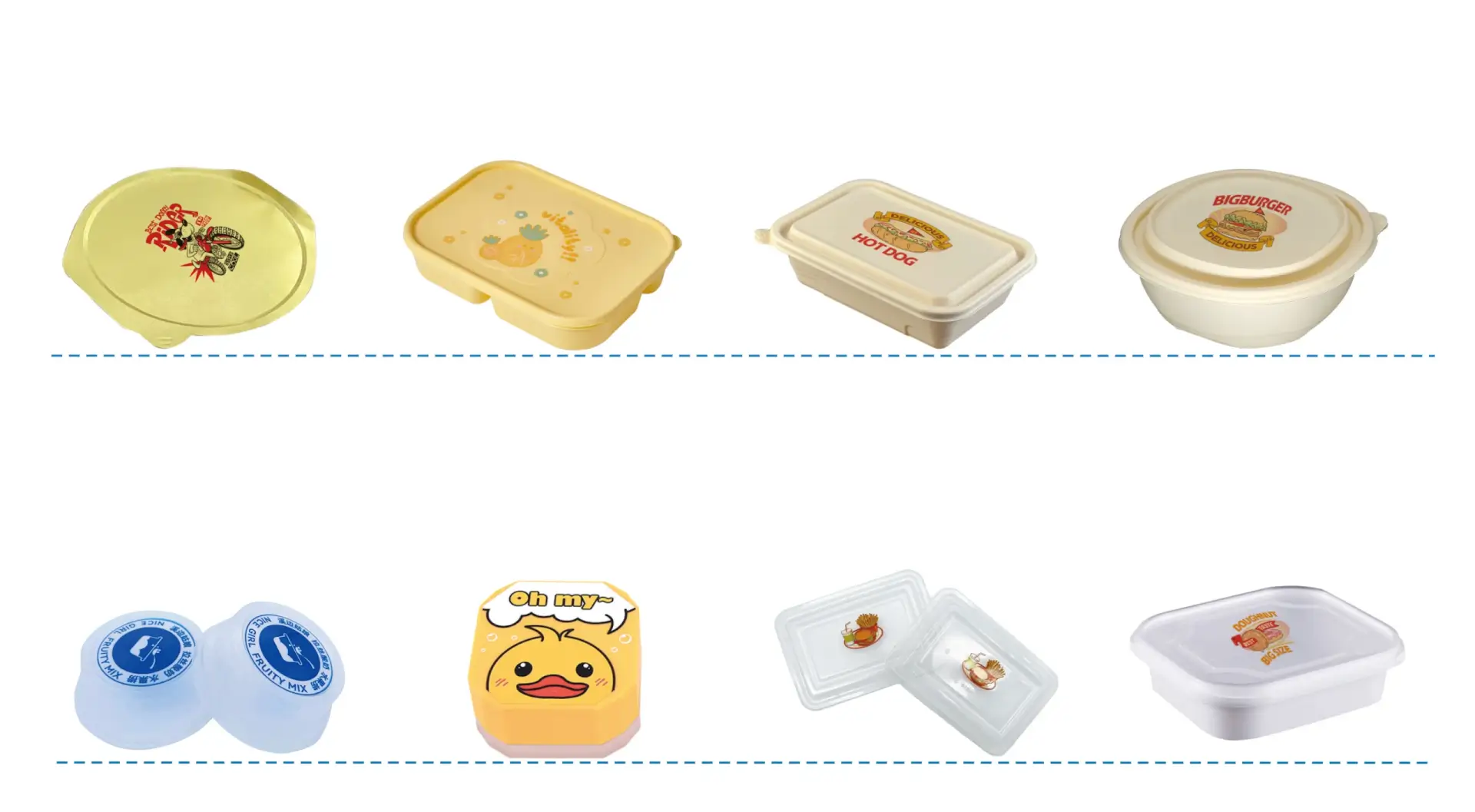
3.Proper use of maintenance and cleaning fluids and protection of the nozzles
One of the main reasons for the significant reduction in the service life of industrial nozzles is the misconception of “one bottle of cleaning solution hits the world” that many factories have when maintaining equipment.
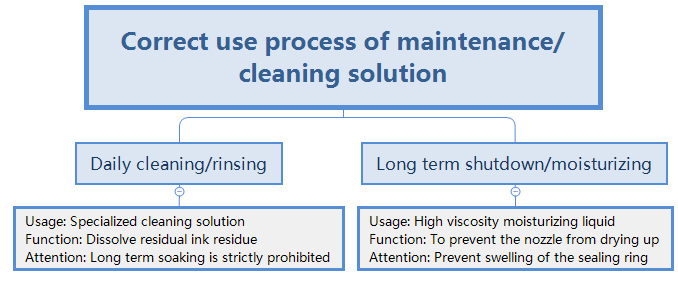
1.difference between cleaning solution and maintenance solution (moisturising solution)
Cleaning Fluid: It is rich in organic solvent components, with strong polarity and quick cutting off the molecular chains of uncured resin. It is only used for short reverse flushing during system flushing or in case of severe blockage. If you soak the nozzle for a long time in a strong cleaning solution, the internal glue of the nozzle will be peeled off, and the sealing ring will be swollen.
Preservation Fluid: The formulation is composed of high boiling point polyols and mild solvents. Viscosity is slightly high and it is very difficult to evaporate. Its main function is to stay in the nozzle cavity to block air and keep the ink channel wet, suitable for daily shutdown or holiday shutdown protection.
2.Standard shutdown maintenance and long holiday sealing procedures
If equipment is down for more than 3 days, standard sealing procedures shall be followed:
- Cleaning of the ink path Flush residual ink (especially white ink that is easy to precipitate) out of the ink cartridge and flow channel thoroughly using an ink pump, injection of the corresponding exclusive cleaning solution, and rinse until the effluent is colourless and transparent.
- Air evacuation : Remove cleaning solution to prevent residual cleaning solution from diluting next moisturising solution.
- Fill with moisturising solution: Slowly inject the special maintenance moisturising solution from ink pressure channel, to ensure all nozzle holes have a slight leakage of moisturising solution.
- Physical sealing: Dip a dust-free cloth in a small amount of moisturising solution and stick it to the bottom plate of the nozzle and seal it with special moisturising cover(Caping Top) or cling film to cut off UV radiation and contact with air.
For maintenance, please refer to the standard maintenance process of industrial nozzles for detailed diagrams.
3.Avoid such taboos as nozzle blockage and damage of piezoelectric crystals.
Taboo 1: Do not mix different brands of cleaning solution and ink. Different chemical systems can meet up, and sediment or gel can be formed, and the nozzle of only ten microns diameter will be blocked immediately.
Taboo 2. Ultrasonic overload. If the nozzle is cleaned ultrasonically with an inappropriate frequency or power, it is easy to cause the piezoelectric crystal to break or the internal circuit to open circuit.
Taboo 3: Use strong degreasing solvents (acetone, ethyl acetate in high concentrations, etc.) . Such solvents can destroy the anti-fluorine coating of the nozzle, resulting in poor ink ejection, or serious oblique spraying.

4.How to establish standardisation of consumables management and cost control?
Standardised management of consumables not only guarantees stable quality, but also is an important strategy to reduce the total cost of production (TCO) for medium and large-scale printing or processing enterprises.
1.Full warehousing and storage standards
Avoid light and heat: UV ink and varnish are very sensitive to light, and the temperature of the storage environment should be strictly controlled at $18 \sim 25 ^ \ \circ \text {C}$, and humidity should be maintained at $40 \% \ \sim 60$.
First in, first out (FIFO): UV ink has a shelf life of 6 to 12 months (white ink generally 6 months). Expired ink can easily result in poor curing and clogging, caused by failure of photoinitiators or pigment aggregation.
Regular shaking of white ink If white ink is not used, it should be shaken manually or automatically on the machine once a week to prevent the titanium dioxide settling to the bottom and forming clumps.
2. Consumables Cost Optimisation Plan
Control the base coating range If non-full plate printing is needed, vector masking is used to spray the base coating precisely, preventing base coating waste from global spraying.
Flashing and ink discharge in a reasonable range: Flashing frequency can be set according to the ambient temperature and humidity. A high flash frequency results in waste of ink and a low frequency has the risk of clogging.
If you are considering replacing equipment or have strict industrial-grade computing power requirements for consumable use, you can learn about our industrial-grade UV digital printer equipment solutions and get professional calculation reports.
5.Misconceptions and risk avoidance in the application of consumables
Safety and prevention reminder: UV ink and pre-treatment primer contain active monomers and photoinitiators which may cause allergic dermatitis in case of direct skin contact. Be sure to wear nitrile gloves and protective goggles when operating it. In case of contact with eyes, immediately flush eyes with plenty of water for at least 15 minutes and seek medical attention immediately. A good local exhaust system should be available in the workshop to reduce the concentration of volatile organic compounds (VOCs).
Misconception 1: “The more the ink is thick and the more the pigment content is high, the better
Fact: Too many pigment particles grouped together can increase the viscosity of the ink, which can exceed the dot spray limit of the nozzle, resulting in missing nozzles when printing at high speeds.
Misconception 2: “You can use pure anhydrous ethanol instead of specialised cleaning solution.”
Fact: Anhydrous ethanol has strong dehydration ability, which can easily lead to the quick solidification of some resins, and the long-term use can reduce the sealing life of the anti-precipitation properties of the nozzle.
Misconception 3: The higher the temperature of the heated ink cartridge, the higher the quality of the ink.
Fact: Ink cartridges are heated to reduce the viscosity of the ink to meet the requirements of the nozzle ignition. If the heating temperature is too high, the photoinitiator in the ink will undergo thermal polymerisation reaction faster, and the stability of the ink in the ink path will be reduced.
Related guides and further reading
Material Compatibility & Core Component Selection Guidelines for UV Digital Printers
Master the application adaptation of UV digital printers on different industrial materials, the selection logic of nozzles, boards and board transmission systems.
Routine maintenance procedures of industrial nozzles
Understanding the ink pressing, wiping and anti-drying maintenance process of Ricoh G5/G6, Kyocera , and Epson industrial nozzle
UV-LED curing lamp power control and wavelength matching
Understand the technical analysis in depth on the matching of curing lamp energy (mJ/cm2) and ink initiator, and solve the problems of surface dryness and lack of adhesion.
Frequently Asked Questions (FAQ)
Q1: Can you use different brands of UV inks together and directly?
No. Different ink brands employ different resin matrices, monomer ratios and photoinitiator systems. Chemical reactions are easy to occur when mixing, which will produce gel or tiny sediment, and damage the micropores of piezoelectric nozzle directly. When you change the ink, you must clean the whole ink way thoroughly with the cleaning solution recommended by original factory.
Q2: Why would white ink be more likely to clog the nozzle than coloured ink?
White ink uses titanium dioxide as the pigment which is considerably heavier and has a much higher molecular weight than the organic pigments in colour ink. White ink is naturally inclined to settle when at rest. Therefore, the system should be equipped with timed white ink circulation and automatic stirring device and keep the normal operation of circulation system during shutdown.
Q3: After printing, the ink layer is easy to peel off. Is it the quality of the ink or the primer?
It is not necessarily a problem of ink quality, but is usually caused by low surface tension or incomplete cure of the material. First of all, it is recommended to perform a Dyne test on the material. If the surface tension is lower than 38 dyne/cm, spray a special primer or perform a corona treatment first. Then check if the energy output of the UV-LED curing lamp is reduced.
Q4: How long can maintenance fluid remain in the ink path without replacement?
In a closed environment without ultraviolet light, a high-quality professional maintenance moisturising cream can maintain a moisturising effect for 15-30 days in the nozzle. However, if the downtime is expected to be more than 1 month, it is recommended to re-energize every 20 days, flush with new maintenance fluid and re-sent the head.
Summary:
The correct understanding and standardisation of the use of consumables for UV digital printers is not only the key to improving the final printing quality and solving adhesion and colour deviation, but also the best way to ensure the long-term stable operation of industrial piezoelectric nozzles and reduce the overall cost. From reasonable selection of hard/soft inks to strict differentiation of cleaning and maintenance fluids, the establishment of a scientific SOP standard for consumables will bring long-term technological advantages and commercial value to your industrial printing business.
No responses yet