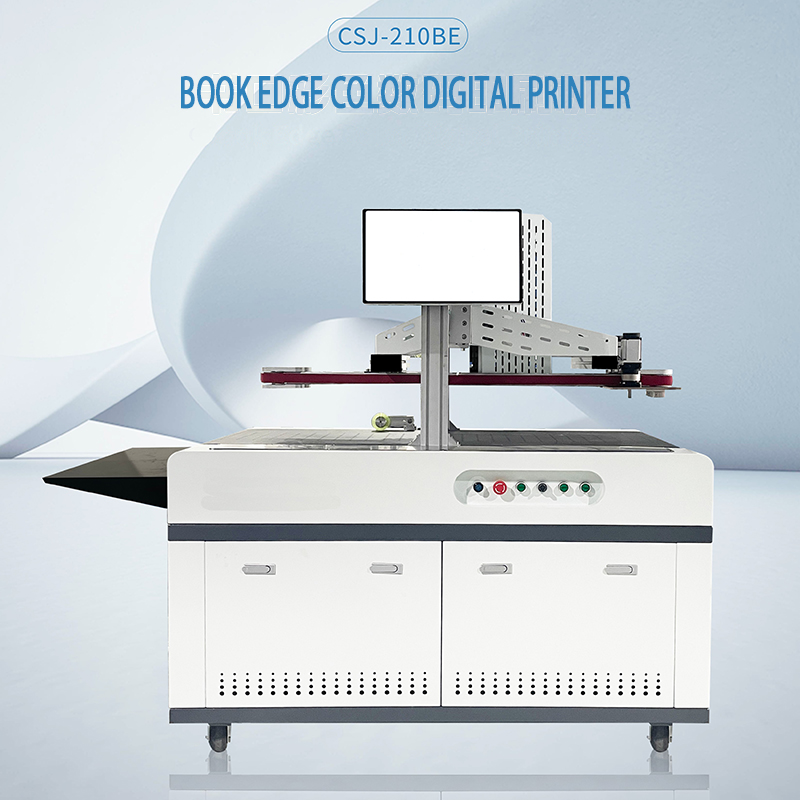
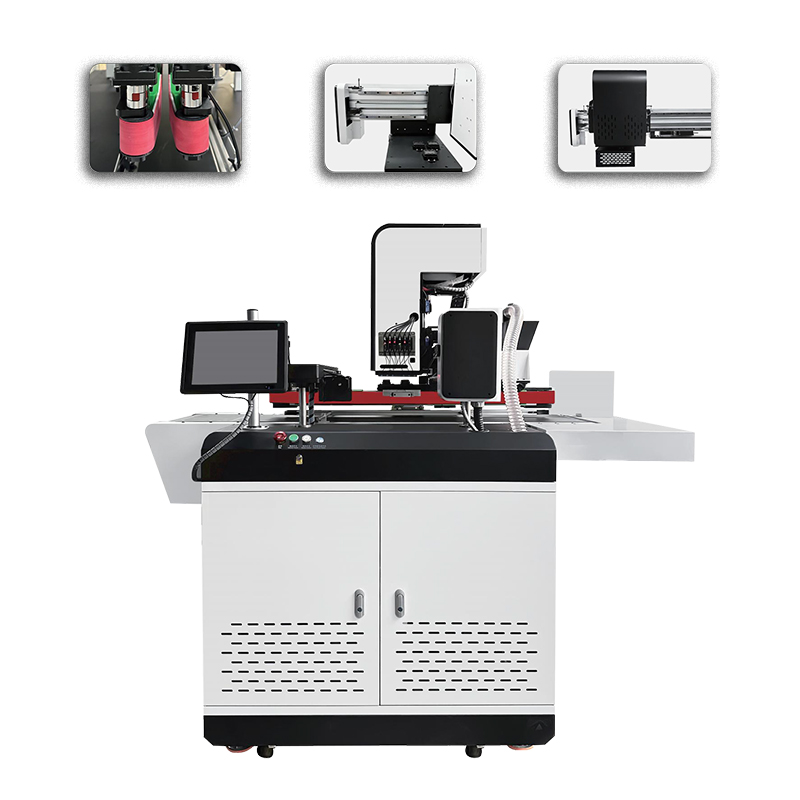
Special edition books are going mainstream from niche markets in the book publishing and printing industry. Special edition books have evolved from niche luxury products to important marketing tools, driven by the rise of reading communities such as “BookTok” on social media and the need for tiered reward mechanisms in crowdfunding projects. Among numerous techniques for special edition books, book edge decoration has become one of the most desired techniques, especially in limited edition and collector’s edition books. Color printing through digital inkjet technology is one of the most desired techniques in special edition books.
The traditional book edge processing methods are hot stamping, hand coloring, screen printing, and so on. These processes either require the creation of molds or screens or rely on manual labor, resulting in extremely high costs and low efficiency when it comes to small batch orders. The appearance of book-edge digital inkjet printers has completely changed this pattern. They do not need to make plate, support printing one book at a time and have the ability to output full-color patterns, which provides a really feasible technical path for small-batch customization of special edition book publishing. Market research indicates that the global special edition book market is expected to exceed US$1.2 billion in 2024, and the proportion of book edge decoration technology will grow at an annual rate of 8%, which will directly promote the growth of the installation of book edge digital inkjet devices.
How do I create a book with edge printing?
In the traditional book edge processing flow, whether it is hot stamping or screen printing, it is necessary to go through the plate-making process. For small batch orders that involve printing the cost of making the plates can be more than 60% of the total cost of the order. That is to say, if the customer only wants one set of books, traditional techniques are almost incapable of completing the production economically, and will either refuse to accept the order or make the customer bear the high cost of typesetting. Digital inkjet technology uses digital files to directly control the nozzle and, as a consequence, the physical printing plates are not used, and finally, the threshold for printing is removed.
This is the core issue that the edge-to-edge digital inkjet printer solves. This equipment is digital inkjet technology, no need of any printing plates or screens preparation. Operators only need to import the designed image files (supporting multiple formats such as JPG, PDF, PSD, BMP, TIFF, etc.) into the device control system, then they can complete pattern switching and start printing in seconds. This “what you see is what you get” digital workflow completely crosses the threshold for printing a book. Take the actual production as an example. A customer of a Shenzhen equipment manufacturer said that after using a book-edge digital inkjet printer, the order that used to require at least 200 copies to break even now only needs 5 copies to get positive profits. As the costs of consumables are only the costs of ink, the ink costs per copy can be contained within 0.5 US dollars.
From a technical implementation perspective, modern digital inkjet printers for book edges have precise feeding and positioning systems. Taking the equipment produced by manufacturers in Shenzhen as an example, after the book core is fixed on a special fixture, the equipment measures the thickness of the printing medium by an automatic height sensing system, and automatically adjusts the print head to the best printing distance. Some equipment also is provided with a brush dust-removal system to remove impurities and static electricity from the book edge surface before printing to ensure precise adhesion of ink droplets. The whole process from clamping to printing is done without complicated parameter adjustments and operators can start after simple training. The device also supports multiple size specifications, from pocket books (width less than 100mm) to large picture books (width over 300mm) compatible. The feeding system uses a stepping motor as the driving device, matched with photoelectrical sensors to achieve accurate control of the position, with a repeat positioning accuracy of ±0.1 mm.
In actual production scenarios, such a capability means that printing service providers can offer “one-book customization” services that were previously unavailable. Whether it is a sample book published by the author at his own expense, or a commemorative album for the corporate annual meeting, or a photo album for a personal wedding, unique edge decoration effects can be achieved through book edge printing. According to data from equipment manufacturers, adopting digital bookedge printing technology can reduce the comprehensive cost of small-batch customization by about 60%. The flexibility of digital processes allows clients to alter the design at the last minute without incurring extra costs, which is very convenient for publishing houses that often need to change sample books. Other devices are also capable of variable data printing so each book can have a different book edge pattern, different serial numbers or personalized messages, and this is a great solution for limited edition books.
True alignment technology for images on three sides of books.
The main difference between book edge printing and traditional flat printing is that the printing surface is the side of the book core, which is a surface formed by hundreds of stacked sheets of paper with a certain degree of roughness and thickness variation. To achieve accurate image reproduction on these surfaces, book-edge digital inkjet printers must overcome alignment challenges in a number of technical areas. Unlike flat paper, the fiber structure of the book edge absorbs ink and produces capillary diffusion, so the print head must accurately control the droplet size and spray angle to avoid pattern blurring or smudging.
The main issue is proper registration. The three sides of the book edge (top, bottom and cut) are not quite flat. In particular the cut surface shows some small hierarchical differences at the edges of the stacked paper. During the Printing process, if there is a deviation between the image and the edge of the book, the pattern will “deviate”. In some severe cases, some of the patterns may even be printed on the cover. Therefore, the high-end book-edge digital inkjet printer adopts multi-level registration technology solution. On the hardware side, the device is equipped with a high-stability fixture system, which can firmly fix the book slide and ensure that it will not move during the printing process. Some models adopt steel gantry frame structure to ensure the long-term precision stability from mechanical point of view . At the same time, it also has a high-resolution linear array camera that scans the edges of the book in real time before printing. Image comparing algorithms are employed for automatic detection of the edge position and the deviation value is fed back to the control system for automatic compensation.
On the printing level, book edge digital inkjet printers generally adopt one-pass printing technology, which means that the print head scans the book edge only once to complete the output of all the patterns and avoids the cumulative errors caused by multiple reciprocating movements. This mode requires the nozzle to be large enough to cover the full height of the book edge. Currently, the nozzle widths of most devices on the market are between 70mm and 150mm. Used in conjunction with high-precision linear encoders, they can realize precise step motion. At the control system level, the device uses an automatic thickness measurement and height adjustment system to detect the thickness of the book slide in real time and adjust the position of the print head, so that the ink droplets are always ejected at an optimal distance to the surface of the book edge. The more expensive models have a dynamic ink droplet adjustment function that automatically adjusts the size of the ink droplets according to the density of the paper in different areas of the book edge, so that the density of the pattern is uniform and consistent.
The hard measure of resolution is equally important. Today the most common digital inkjet printers for book edges reach physical resolutions of 1200 × 1200 DPI or even 1440 DPI. This degree of precision means the device can print large areas of gradient colors and patterns, as well as clearly reproduce small text, lines and QR codes. Experimental data show that in 1200 DPI mode, the minimum recognizable line width is 0.08 mm, and the minimum module size of QR codes (such as QR codes) can reach 0.5 mm, which fully meets the quality requirements of commercial printing. High resolution is a technical requirement for application scenarios of printing variable data (serial number, anti-counterfeiting code, QR code, etc.) on the edge of books.
Additionally, some devices are also equipped with smart registration systems. For example, MGI’s AIS system uses artificial intelligence technology to achieve precise registration in printing, with more than 5 trillion operations per second, to quickly compare and adjust images. The introduction of such technology can make the three sides of the book image stitching and transition continuous and consistent, even if you flip the page many times, the pattern is not destroyed. The intelligent registration system adopted can control the book edge image’s edge offset to within ±0.2 mm, much lower than the industry standard of ±0.5 mm, according to the third-party testing report, and the pass rate has increased from 82% in traditional methods to more than 97%.
How to grow your B2B printing line of business for card peripheral edge printing and sticky notes?
For B2B printing service providers, the value of Book Edge digital inkjet printers goes beyond just special book publishing. The multi-material compatibility and flexible printing ability of this device has created several new business lines for printing businesses. According to industry statistics, the global desktop stationery and card customization market has a compound annual growth rate of 6.5%, and the demand for edge decoration products has grown at a rate of 12%, which provides ample incremental space for printers.
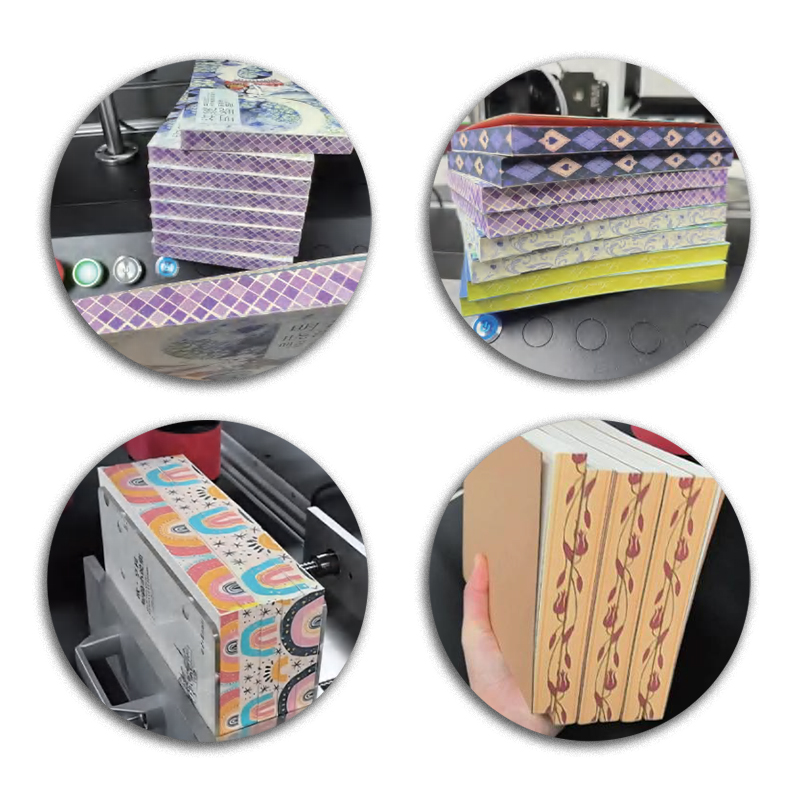
The simplest application extension is the customization of the edges of notebooks and book covers. Edge printing of stationery products such as hardcover notebooks, notebooks and loose-leaf notebooks is becoming a new hot spot for corporate gifts and brand customization. The digital inkjet printer on the edge of the book can print on materials with different thicknesses, from thin sticky notes (about 0.08 mm thick) to thick hardcover notebooks (book core thickness up to 60 mm). The printing width and height can be adjusted flexibly according to product specifications. From a sample to bulk orders, a single device can meet all your production needs. In actual production, printers can contract for orders of corporate annual gifts, exhibition souvenirs, employee welfare sets, etc. The cost of edge printing for each notebook is about 0.3-0.8 US dollars, and the terminal selling price can be increased 3-5 US dollars with a considerable profit margin.
The edge printing of cards and packaging is a more promising development trend. Color patterns can now be printed on the “fifth side” (the edges) of gift cards, membership cards, hang tags, packaging boxes and other products using digital inkjet printers on book edges that are difficult to reach with traditional printing techniques. For brand owners, color printing on the edges of cards is a differentiated way to express their brand. For printing service providers, it means they can break the red ocean of traditional flat printing competition and provide value-added services that competitors cannot easily replicate. For instance, side printing of high-end cosmetics packaging boxes, customized patterns on the edges of hotel room cards, and alternative solutions for gold plating on the edges of game cards have all been successfully implemented.
The book-edge digital inkjet printer has the following technical characteristics: four-color CMYK and multicolor overlay printing, high saturation of colors, natural transition. Different types of ink such as water-based pigment ink, dye ink or UV ink can be selected to meet different material and durability requirements. The UV-LED curing technology allows the ink to dry instantly in the printing process. The patterns have good adhesion, scratch resistance and weather resistance, which is very important for cards and sticky notes that are used and handled frequently. Laboratory tests show that the UV ink printed book edge patterns can be resistant to 500 rubs without significant peeling in the eraser test (ASTM D5264). The color difference value Δ E is still less than 3 after continuous irradiation in the UV aging chamber for 72 hours, meeting the outdoor use standards.
From the business model perspective, the “printless printing” capability of Book Edge digital inkjet printers grants printing service providers high flexibility in taking orders . They can be delivered fast without extra plate-making costs, whether customizing dozens of sticky notes or printing hundreds of membership cards on the edges. The manufacturers of the equipment say their book edge digital printing machines are capable of producing at a rate of 200 books per hour, or 20 to 40 meters per minute. This efficiency makes the small-batch, multi-variety order model economically feasible. Printing service providers no longer need to pursue large batch orders to dilute plate-making costs, but can carry out more diversified and higher profit margin customized services. At the same time, the digital process supports online ordering and real time quotation. Printing companies can create B2B self-service customization platforms, customers can upload design drafts directly and preview the effects. The system automatically generates production files for parallel production significantly reducing the costs of communication and the time required to process orders.
Final Thoughts
There is a rapidly increasing worldwide demand to publish special edition books, small-batch customization. The book-edge digital inkjet printer offers a full technical solution for this market with its technical characteristics including printless printing, one-book printing, high precision printing and multi-material compatibility. From the equipment parameters, the technical indicators are: printing speed is 20-40 meters per minute, maximum resolution is 1440 DPI, support CMYK four-color and multi-color overlay printing, book cores with thicknesses of 0-200 mm, these technical indicators together form the technical foundation for customized production of small batch book edges. Actual production data shows that after adopting this technology, the profit margin of small batch orders for printers can increase from 15% in the traditional way to 35%, the minimum printing quantity of orders can decrease from 200 to 1, and the customer conversion rate can increase by nearly three times. For practitioners in the global printing industry, mastering digital inkjet printing technology for book edges is not only the key to productivity in the era of special edition books, but also an inevitable choice to maintain competitiveness in the wave of mass customization.

No responses yet