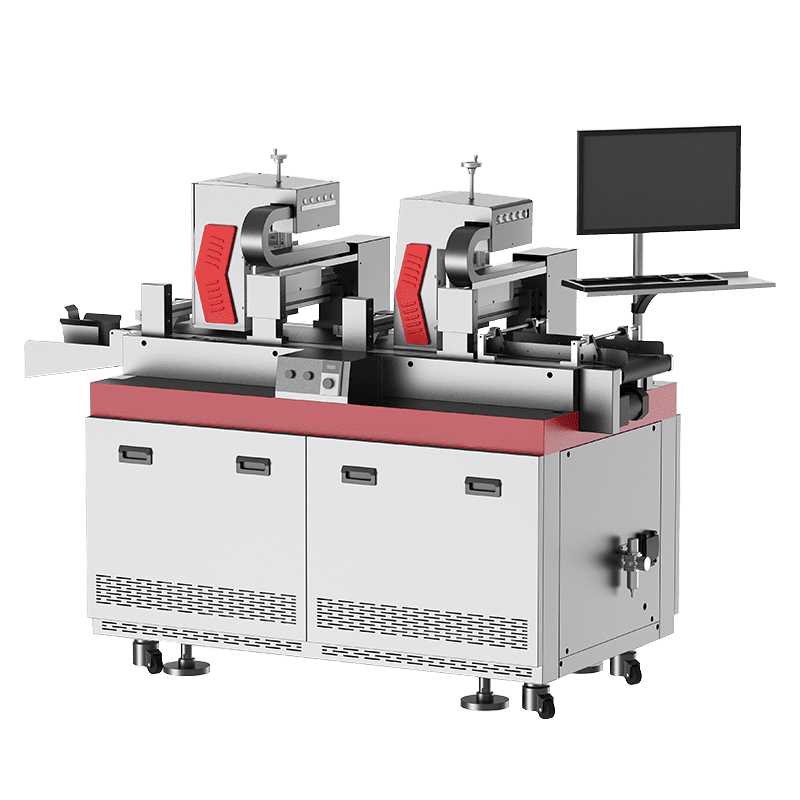
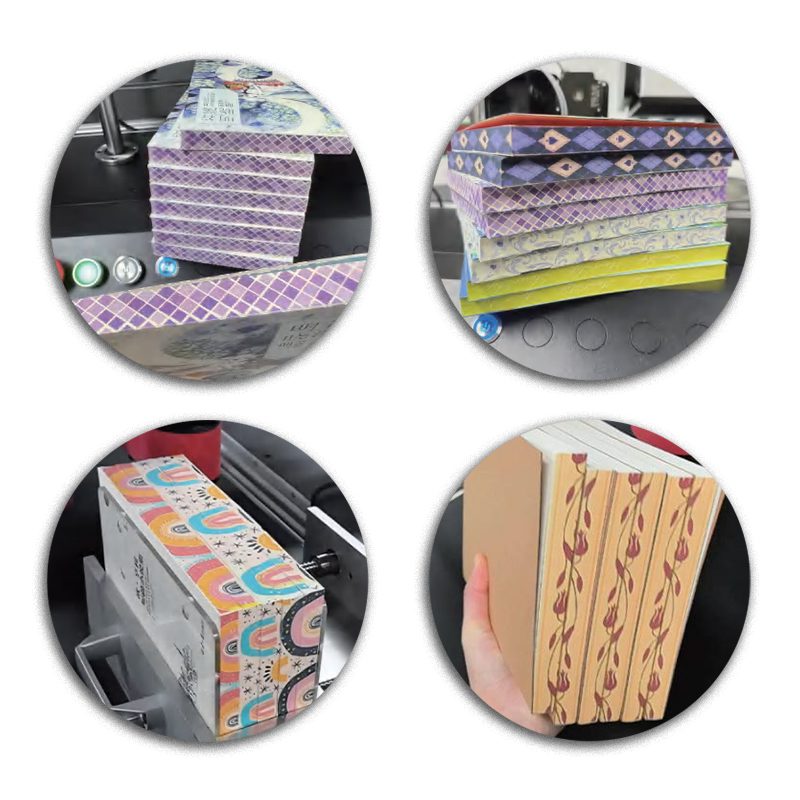
With the growing demand for book binding and personalized printing, book edge printing has progressed from a simple monochrome edge coating to a sophisticated process that includes printing of brand logos, artistic patterns and even QR code information. However, book-edge inkjet printing has long faced two core pain points: Paper flash (i.e. fiber burrs and paper scraps generated at the edges of the paper after cutting) leading to nozzle clogging and printing defects; Ink penetration spreads along the direction of paper fibers, causing blurry patterns and decreased color saturation. These issues are addressed in modern bookedge digital inkjet printers with systematic engineering solutions through precision mechanical control, intelligent air flow management and advanced ink-path systems. This article will analyze how high-precision book edge digital inkjet printers can overcome these industry challenges one by one from four dimensions of technology.
Ensure that the logic of the edge printing on heavy paper is within ±0.1 mm accuracy.
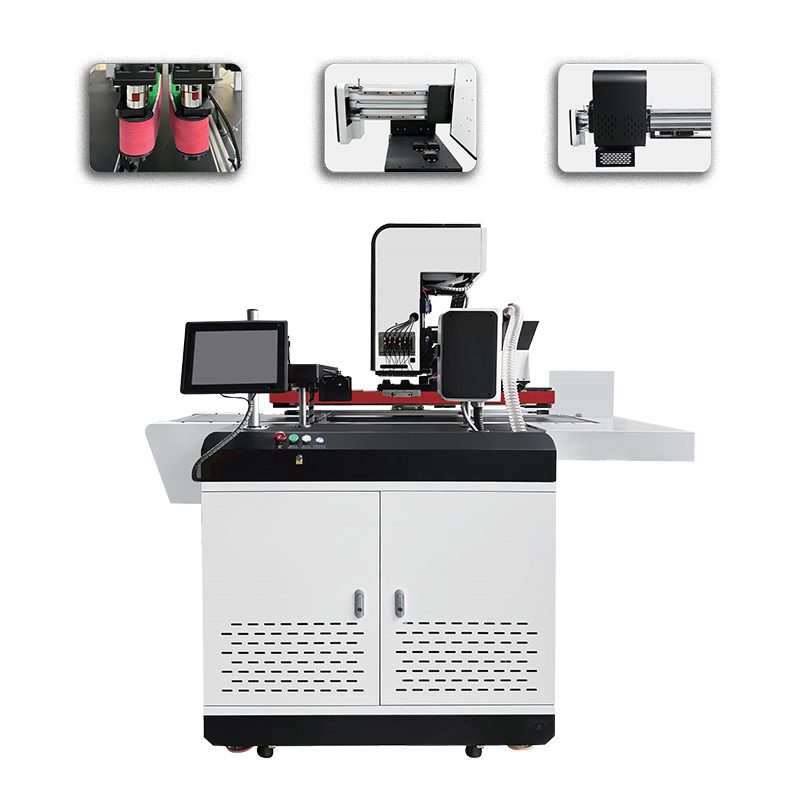
The paper firstly depends on the precise feeding and positioning system of the book edge digital inkjet printer to realize the registration accuracy of +0.1 mm for book edge printing. When driving multiple sets of synchronous conveyors, closed-loop servo motors are commonly adopted, and the thickness and height of books are detected in real time by laser or mechanical sensors to automatically complete position calibration. The front and back registration accuracy of the industrial inkjet digital printing machine MK600DPB can be controlled within ≤± 0.1mm, and the printing accuracy can reach 1200dpi × 1200dpi. This level of accuracy is achieved by controlling the micrometer motion of the nozzle module on the X / Y / Z axes and the real-time feedback information from the high-precision meter wheel on paper length.
Secondly, high grammage paper (generally paper in the range of 60-350 gsm) is more difficult to print using inkjet. The thicker the paper, the denser the fiber layer, and the more complicated the path for ink penetration at the edges. The digital inkjet printer of book edge adopts multi-bit deep network and high-precision screen-hanging and inkjet control technology to make the text edges sharper. Meanwhile, the inkjet system uses industrial level on-demand piezoelectric nozzles, which can accurately control the landing position and volume of each ink droplet, reducing the lateral diffusion of ink in paper fibers from the source. Some of the higher-end models even have a dual color management system that is capable of producing color setup files for both the long and short edge of the book, correcting for color shifts caused by differences in the direction of the fibers. It is this very precision management in a closed loop from mechanical transmission to the control of ink droplets that enables to print clear and scannable QR codes on the edges of paper of high weight such as the hardcover of books and laptops.
How can I control the airflow and utilize the dust removal system to stop the paper scraps from clogging the nozzle?
Paper flash causes paper debris, the “number one killer” of inkjet print heads. If paper scraps adhere to the nozzle plate, ink droplets may be deflected and white lines appear on the pattern. In the worst case, the nozzle may be completely blocked, causing irreversible printing defects. BookEdge digital inkjet printers have two methods to combat this problem: “active defense” and “passive cleaning.”
At the level of active defense, the device creates a system of air curtains with positive pressure around the nozzle. A “airflow wall” is formed between the nozzle and the edge of the paper by blowing laminar gas at a specific angle and pressure under the nozzle plate, which physically isolates the paper scraps and dust particles generated by cutting outside the nozzle area. Some models employ ionized air nozzles to eliminate static electricity and blow away paper scraps, thus preventing the adsorption of dust on the surface of the nozzle as a result of static electricity. At the passive cleaning level, the book-edge digital inkjet printer is provided with an adjustable brush during the feeding process. It physically cleans the book edge before entering the printing station to take away the loose impurities on the surface. Some of the devices are also internally integrated with vacuum cleaning systems to vacuum the dust generated during the printing process in real time. In addition, non-stop inkjet technology (i.e. continuous circulation of ink during non-printing times) can help prevent ink from drying and clogging inside the nozzle. The quadruple protection system of “air curtain isolation + brush pre-cleaning + vacuum suction + ink circulation” minimizes the probability of nozzle blockage and guarantees the stability of long-term continuous production.
Full automatic recognition and switching process of book edges rounded and square corners
The geometric shape of book edges is mainly divided into two types: square corners (cutting of right angles) and round corners (arc-shaped chamfering). Traditionally, switching between these two processing modes requires manually adjusting fixtures or swapping out paper pressing modules, which is slow and error prone. Modern book edge digital inkjet printers realize the fully automatic recognition and switching by sensor arrays and intelligent algorithms.
When the book enters in the feeding platform, the built-in sensors of thickness and height accomplish a three-dimensional size scan automatically detecting if the book edge is a right angle or a rounded corner. For the rounded book edges, the control system adjusts the distance between the nozzle and paper edge dynamically. Because of the curvature change at the rounded corners, the distance of the nozzle spraying on the arc trajectory should be kept constant to avoid the ink accumulation at the vertex of the arc or ink missing on both sides. Square corners of the book edges are scanned on a straight path in standard mode. This recognition and path planning process is fully automatic and there is no need for manual intervention by the operators. Based on production data, digital inkjet printers with automatic recognition systems can reduce the switching time between different books from the traditional 15-20 minutes to just a few seconds. This process flexibility allows printing companies to accept orders for hardcover corner books and flat-corner textbooks at the same time without changing models, greatly improving equipment utilization and flexibility in production scheduling.
Application of book-edge inkjet equipment embedded in a fully automatic rear-binding line.
Printing on book edges is not the end of book production, but an important part of the post-press binding process. The real value of a book-edge digital inkjet printer lies in its integration into an automated back-binding (i.e. lockstitching) production line, which allows continuous operations from printing to book completion.
In the general automatic binding process, a barcode or positioning mark that meets the recognition requirements of the digital locksmith needs to be sprayed on the back of the book before entering the digital locksmith. The high-speed printing of the book-edge digital inkjet printer (some models can reach a production speed of up to 150 meters per minute) allows the printer to accurately print marks during the book-slide conveying process. After printing, the book core is directly sent to the lockstitching station, where the scanning system reads the marking information and automatically matches the corresponding binding parameters (lockstitching needle spacing, wire tension, etc.) to realize the fully automatic lockstitching book core processing. In addition, modern bookedge digital inkjet printers can be integrated online with three-sided cutting equipment, book core folding production lines and wireless adhesive binding linkage lines. The whole printing process, book core production, automatic input, adhesive binding technology and three-sided cutting can be finished in one paper feeding. This embedded design concept turns book edge printing into not a separate decorative process, but an intelligent node integrated with bookbinding, which greatly reduces the transportation and manual handling of semi-finished products, and improves the overall efficiency of the production line by more than 95%.
Summary
From the analysis of the four technical dimensions described above, we can draw the following conclusion: Modern book-edge digital inkjet printers have a registration accuracy of ± 0.1 mm in the wide paper range of 60-350 gsm due to a closed-loop control system and precision servo transmission. Quadruple protection system, including positive pressure air curtain, brush pre-cleaning, vacuum suction and ink circulation, reduces the nozzle blockage failure rate to an extremely low level. With sensor arrays and intelligent path planning, the automatic recognition between the rounded-corner and square-corner book edges has been achieved in seconds . The whole line production efficiency has been improved by over 95% through the adoption of high-speed printing and a common data interface to seamlessly embed the rear lock line and adhesive linkage line. Furthermore, the equipment adopts industrial-grade stainless steel frame and long-life nozzle (service life up to 5 years with good maintenance), supports CMYK four-color and spot color printing, and the material compatibility covers various substrates such as offset paper, digital paper, copperplate paper, etc. The data and technical facts prove that book-edge digital inkjet printers have developed from a single decorative device to an industrial-grade production tool with high precision, high speed and high automation, laying a reliable technological foundation for the global printing industry.

No responses yet