Water-based digital printers are non-toxic, odourless and highly environmental-friendly, and have rapidly gained popularity in the field of packaging and corrugated printing. But in reality, production companies often face four big problems: slow drying time limits production capacity, paper deformation caused by excess water absorption, heavy dependence on special coatings, and nozzle drying and clogging problems. The solution to these problems is to use a combination of “IR infrared + hot air drying” to speed up drying, apply “online pre-coating” to enhance colour and durability, and work with an ink path system that allows for full circulation to minimise clogging issues. If you want to fully understand the equipment parameters and selection logic, you can refer to our water-based printer technology panorama and selection guide.
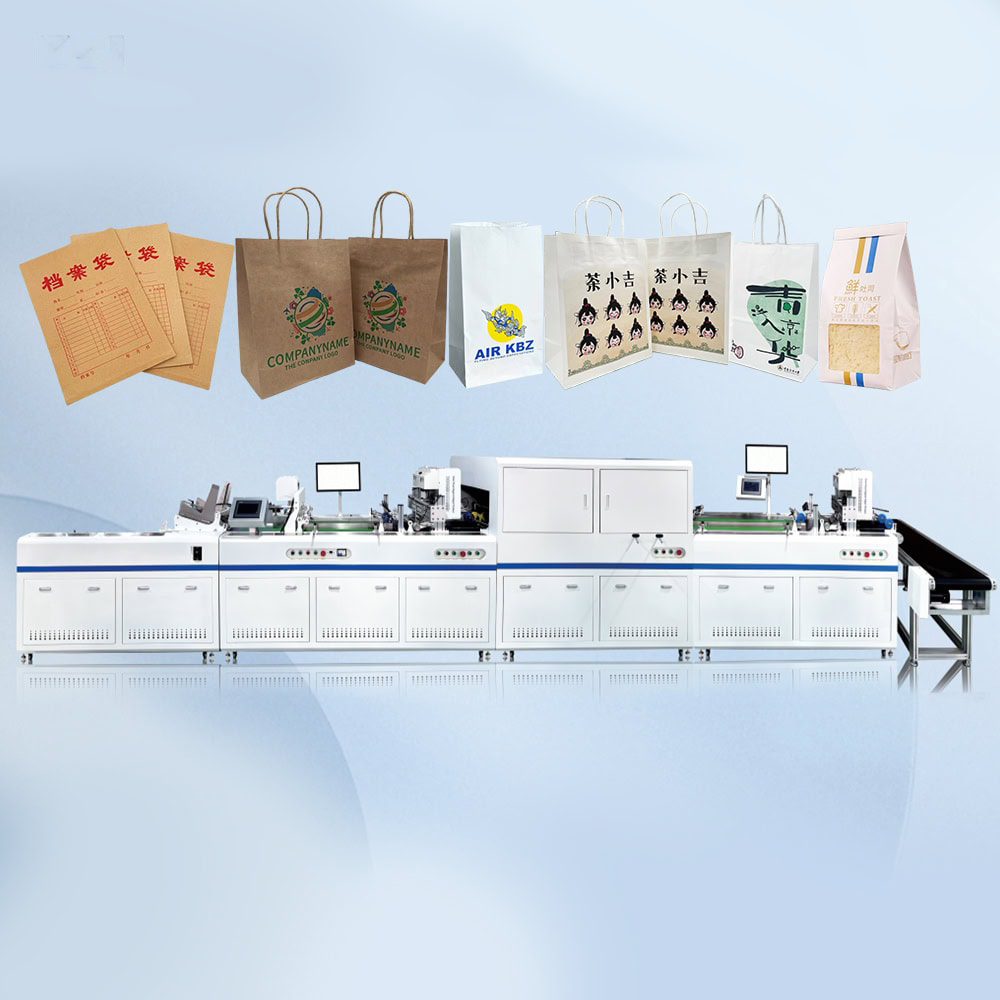
1. Why do we love and hate water-based digital printing technology?
Traditional solvent-based and some UV printing processes are coming under increasing restrictions driven by increasingly stringent global environmental regulations and a rising demand for food-contact-grade packaging. As global environmental regulations tighten and the demand for food-grade printing increases, some of the UV and solvent-based printing processes are becoming more limited. Water-based digital printing technology is the key technology of green transformation for packaging and printing industry, because of its zero or near-zero release of volatile organic compounds (VOCs).
However, with the advent of professional water-based digital printers, many printing companies have found that there is a certain gap between the actual production experience and expectations. Water-based ink is a type of ink in which water is used as the main dispersing medium, which leads to its extremely high environmental and safety properties. But it also provides natural bottlenecks in terms of physical drying, medium adaptability and durability of continuous equipment operation.
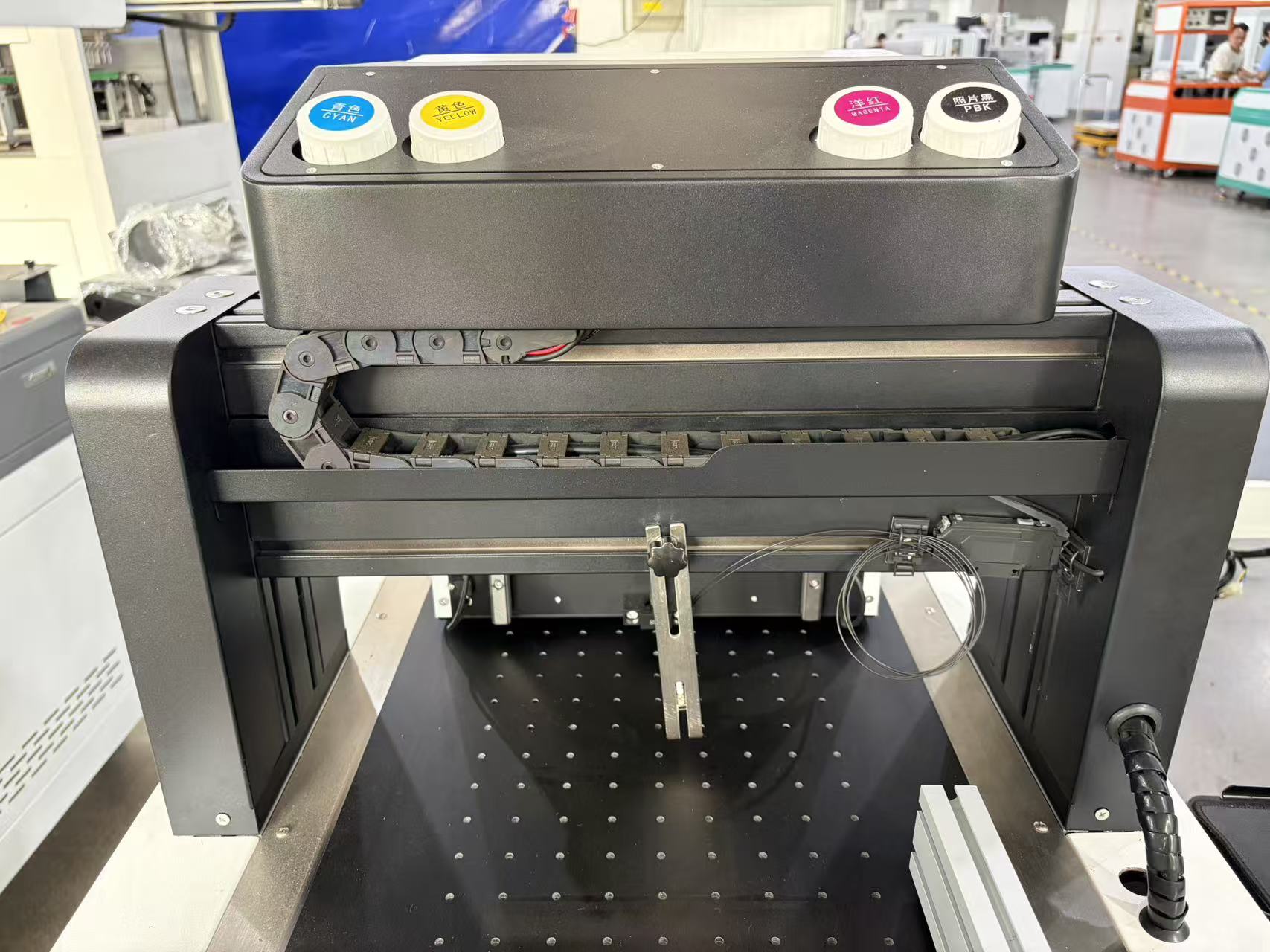
2. Detailed analysis of pain points in the four core industries of water-based digital printing
For the industrial packaging printing scenario, we have summarised the pain points that often occur in the actual production of water-based digital printers as follows:
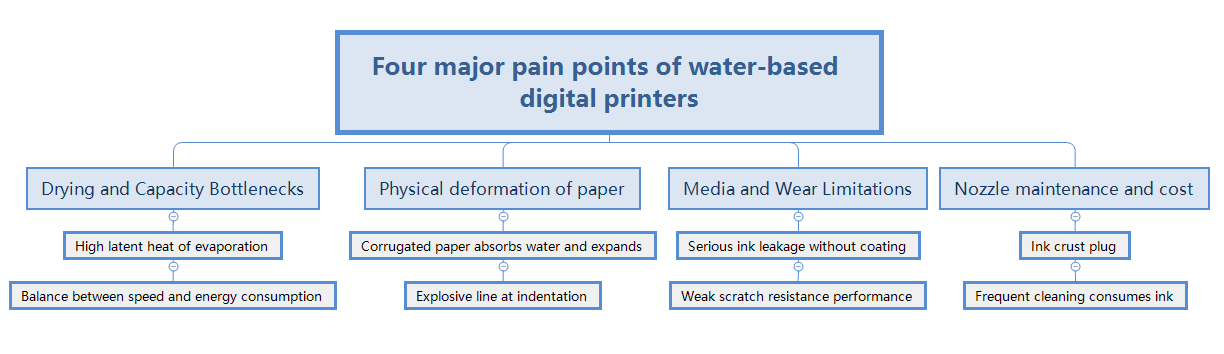
Pain point 1: Slow physical drying v. production efficiency
The latent heat of evaporation of water is about $2260 kJ/kg, much higher than organic solvents. This means that the moisture in water-based ink needs a lot of heat energy consumption to be totally evaporated.
Speed limit: When printing at high speed (e.g. $>75 \text { m/min}$), back sticking (blocking) can take place during winding or stacking paper if the heat supply of the drying system is not sufficient.
sudden increase in energy consumption: the drying will be forced and will need a considerable increase in heating power, with a sharp increase in the cost of electricity of the factory, annulling the cost saving of digital printing without plates.
Pain point 2: Paper deformation and rupture caused by water absorption
If you spray water-based ink on untreated cardboard or regular corrugated paper, the fibres absorb moisture and quickly swell, then contract dramatically as they dry.
Wave Edge and Arching: If the paper is thin or of low weight corrugated paper, it is easily deformed locally and arched after absorbing a large amount of water-based ink and may even scratch precision nozzles.
Cracking: Ink penetrates deep into the paper and breaks the original tension distribution of paper fibres. Creases are prone to surface rupture during subsequent die-cutting and box folding.
Pain point 3: Dependency on coating and low surface wear resistance
Water-based ink is mainly based on film-forming resin, which polymerises and forms a film after water evaporation. Unlike UV ink, which is based on photopolymerization to form a rigid film layer.
Low scratch resistance: Water-based printing surfaces that are not protected can be easily discoloured and scratched during transportation and friction.
Coating cost: High-grade copperplate paper or special coated paper is used. The colour reproduction is high but the medium cost increases significantly. If ordinary base paper is used, the ink is prone to spreading and causes image blurring.
Pain point 4: blockage of the nozzle and stability of continuous operation
When the resin in the water-based ink is exposed to air, the water will quickly evaporate, and a microgel will form at the very small aperture (usually more than ten microns) of the nozzle.
Broken needles and flying ink: If the nozzle is not adequately protected during a brief shutdown of the equipment (e.g. changing paper rolls or troubleshooting), it can skin, leading to wire drawing, broken needles or flying ink when restarting.
Frequent use of ink rinse nozzles reduces effective production time but also creates substantial ink waste due to maintenance wear and tear. This problem is particularly visible before the implementation of the daily maintenance and blockage prevention process for industrial-grade nozzles.
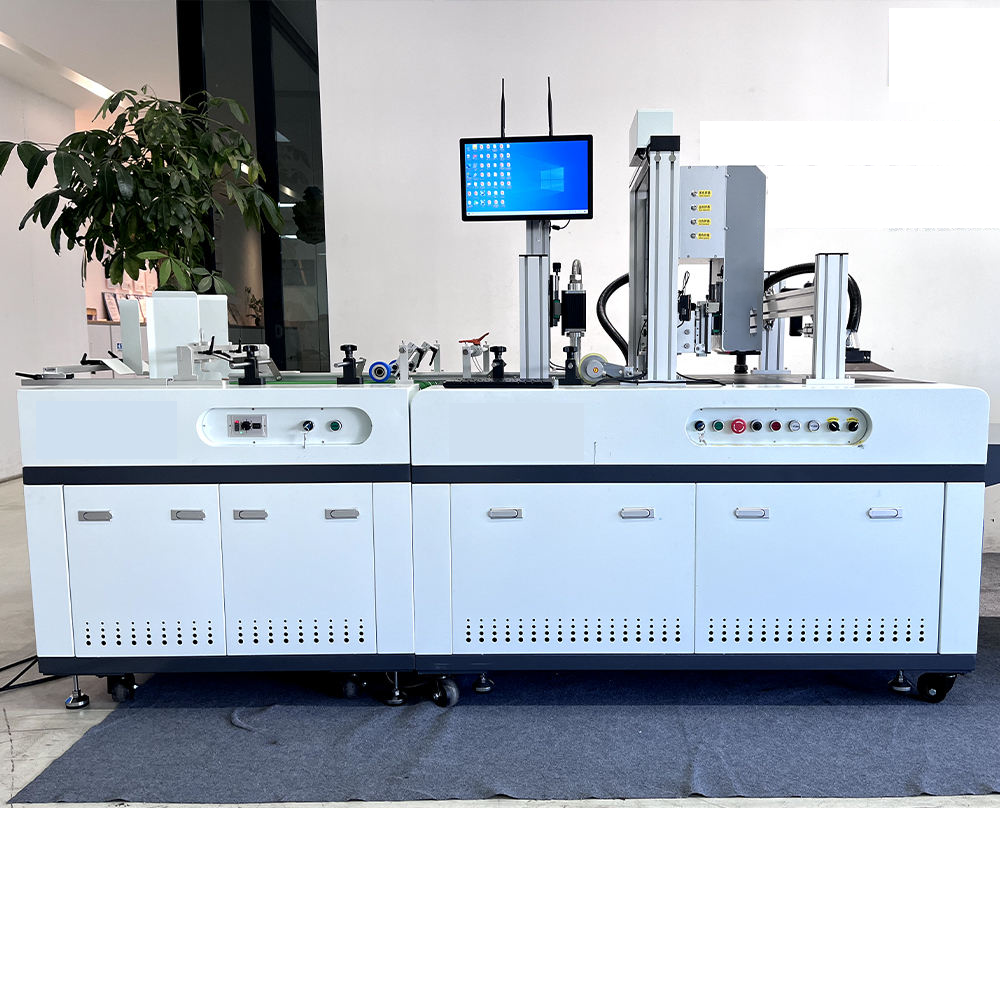
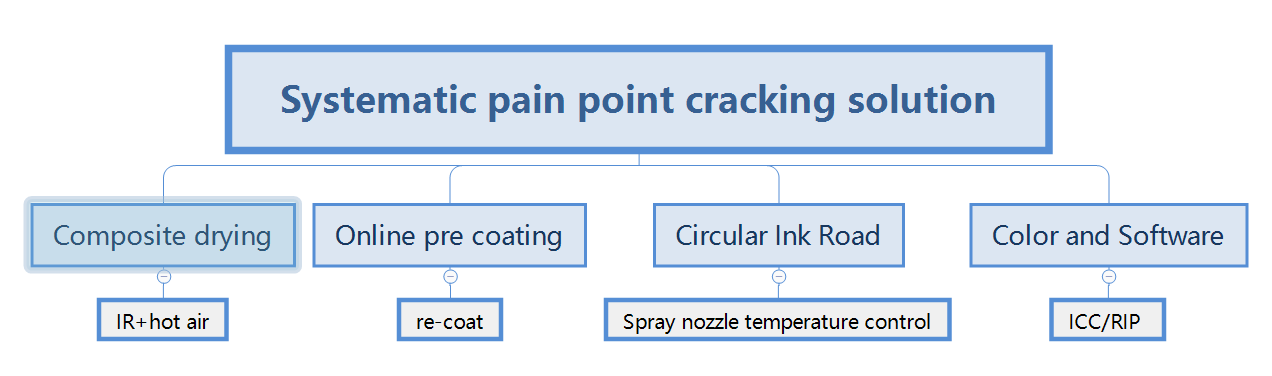
3. Systematic solution for pain points of industrial grade water based digital printing
Modern water-based digital printer solutions overcome the above physical and technological limitations not only through device hardware, but through a three-in-one system engineering approach combining “device + process + software”.
1.This technology is a combination of hot air and infrared (IR) drying methods
It is no longer possible to meet the needs of medium and high-speed printing for the drying bottleneck only by conduction heating or hot air. The most popular industrial solution today is a composite drying system of IR (Infrared radiation) and high pressure hot air.
Principle: The IR radiation passes through the ink layer and acts directly on the paper joint and the inner moisture layer is vaporised quickly. Because of the hot air removing saturated water vapour from the surface, the inner layer of moisture cannot be vaporised. The hot air quickly takes away the saturated water vapour from the surface avoiding the condensation of water vapour.
Benefit: Drying efficiency improved by $30 (no increase in excessive energy consumption (-50%)); For the setting of the energy efficiency ratio of the drying module, please refer to the technical document for the in-depth configuration of the water-based ink high-efficiency drying system.
2. Media pretreatment and pre-coating process
Precoating is the key to solving the adaptation of water based ink to ordinary paper.
Mechanism of action: A thin layer of primer is applied to the paper surface by gravure screen rollers or digital spraying units before printing. The pretreatment solution’s coagulant can quickly chemically aggregate with the pigment particles of the water based ink, locking the pigment to the surface of the medium.
Effect: Not only can it prevent the ink from penetrating deep into the paper to form wavy edges, but also improve the density and colour saturation significantly, and reduce the consumption of ink.
3. Temperature-controlled nozzle and ink circulation system technology
Industrial grade professional water-based digital printers adopt internal circulation technology of ink inside the nozzle, which solves the problem of water-based ink drying and clogging completely.
Behind the nozzle plate the ink flows at high speed for 24 hours, constantly, and even if it is not sprayed, the ink continues to flow and does not stagnate or dry up at the nozzle mouth.
The precise control of the nozzle temperature in combination with this technology ensures that the ink viscosity is always in the optimal spraying range (usually $3 {–}8 \text{ mPa}\cdot\text{s}$).
4. Automated colour and process control
Another way to reduce the burden and cost of drying is to reduce the amount of ink used at the software level. Through the cooperation of the intelligent software for digital printing process management and the ground colour removal (GCR/UCR) algorithm, the total ink limit (TAC) in the overlapping printing can be reduced, but the visual colour consistency can still be maintained, which can alleviate the problem of excessive water absorption on paper from source.
4. Assessment of procurement and implementation: How to avoid pitfalls?
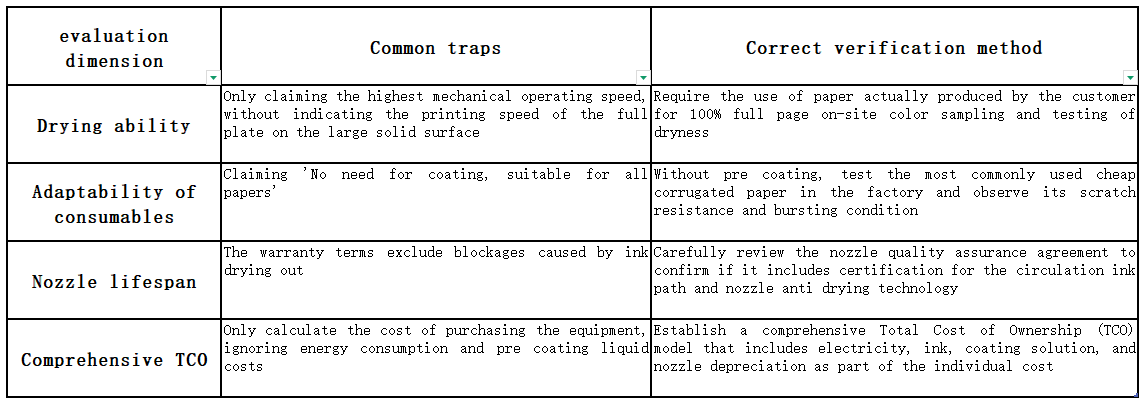
If an enterprise is buying or upgrading water-based digital printing equipment, it is suggested that they make a comprehensive evaluation according to the following checklist, instead of the speed claimed by the equipment manufacturer only.
Checklist for Choosing Equipment and Avoiding Pits
5. Technical limitations, and tips for safe operation.
Engineering and Safety Tips
High temperature and electric safety Industrial water-based digital printers are equipped with high power IR drying units, and the local temperature inside the machine can reach $100 ^ \circ \text{C} \text{–}200 ^\circ\text{C}$. When the equipment stops or paper jams, it is necessary to check whether the anti-infrared overheating protection and automatic knife / oven return mechanism work properly to prevent the paper from igniting.
Water-based is not equal to zero discharge standard: The ink cleaning wastewater of water-based ink, although low toxicity, still contains polymer resins and pigments, and it cannot be directly discharged into municipal sewage pipelines. It has to be physically precipitated or evaporated and concentrated before being delivered to professional environmental protection agencies for treatment.
Engineering and technical consultation: For surface tension and coating matching of specific media, it is recommended to contact a senior application specialist from the equipment manufacturer for on-site measurement. No illicit chemical additives.

6. Frequent Errors and Solutions
Misconception 1: Assuming “water-based environmental protection” implies no need for ventilation and protection at all
Water-based ink does not have a lot of VOCs, but in high-temperature drying, the moisturising agent (such as polyols) in the ink and the moisture in the paper will be evaporated, producing a lot of high humidity hot air flow. If the ventilation of the workshop is not smooth , the humidity inside the oven will be too high , which will reduce the drying efficiency and even cause condensation water droplets inside the equipment to damage the electronic components . Therefore the normal exhaust and dehumidification system in industry is still indispensable.
Myth 2: Pursuing “high DPI” blindly without considering the balance between the size of the ink droplet and its drying properties
Many buyers believe that a higher DPI is better, but in corrugated packaging printing, a physically too high DPI often leads to too much ink per dot or too dense a dot matrix. If the drying power is insufficient, the ink accumulation caused by too high DPI will not only fail to improve the clarity, but also cause the pattern edges to blur and the paper to deform due to ink diffusion (bleeding).
7. Related Guides & Further Reading
Waterborne Printer Technology: An Overview and Selection Guide
Working principle, hardware architecture and core selection framework of water-based printers in different industrial scenarios.
Installation of a high efficiency drying system for water based ink is important.
This section describes the effect of IR, hot air, wind knives and wind speed on the evaporation rate of water-based ink moisture and engineering configuration strategies in great detail.
Industrial-grade nozzles require daily maintenance and to remain free from clogging.
The system will introduce cleaning and moisturising, ink pressing and protection procedures for the water-based digital printing nozzles during long-term shutdown.
8. Frequently Asked Questions (FAQ)
Q1: How to avoid wire breakage when printing corrugated paper with water-based digital printer?
A: There are three main ways to prevent wire breakage: first, add a pre-coating of wire quality before printing to improve surface toughness; Second, optimise the ink limit in RIP software to avoid excessive ink accumulation in crease areas; Third, control the drying temperature to avoid overheating and drying, which can cause the paper to become brittle due to excessive moisture.
Q2: What is the lower cost of production for water-based digital printers than UV digital printers?
A: Depends on the medium and volume of the print. Water-based ink is usually cheaper on a per-unit basis than UV ink and doesn’t require the high power consumption of UV curing lamps. Water-based printing on uncoated media may incur an increase in the cost of pre-coating solution and drying electricity. Generally, the cost and environmental compliance benefits of water-based digital printing are more pronounced for food-grade packaging and short run medium to high volume orders.
Q3: Water-based ink can accumulate or crack when printed on some types of copperplate paper.
A: Copperplate paper has a non-absorbent or low-absorbent surface coating, and the surface tension is relatively low. If the surface tension of the aqueous ink is too high, it cannot be evenly distributed on the paper surface, but will form beads (inks). If the resin dries too quickly and has poor film-forming properties, microcracks can appear. The solution is the use of water-based specialised digital copperplate paper or corona treatment and pre-coat before printing.
Q4: What special maintenance is needed for water-based digital printers to shut down overnight?
A: Run the automatic capping process to ensure the nozzle is fully adhered to the moisturising ink stack. For the ink path equipment that is not continuously circulating, a special moisturising solution or protective solution must be injected, and it is strictly forbidden to directly expose the nozzle to dry air.
9. Conclusions and Technical Opportunities
Water-based digital printing technology is the green future of modern industrial packaging printing. Drying has objective physical pain points, such as paper deformation and medium adaptability. With the popularisation of circulation nozzle technology, upgrading of efficient composite drying system and maturity of online pre-coating process, these bottlenecks are being overcome one by one.
For printing enterprises, the key to giving full play to the advantages of water-based digital printers in high environmental protection, no printing fees, and rapid response is to objectively understand the pain points and establish a reasonable process control flow.
No responses yet